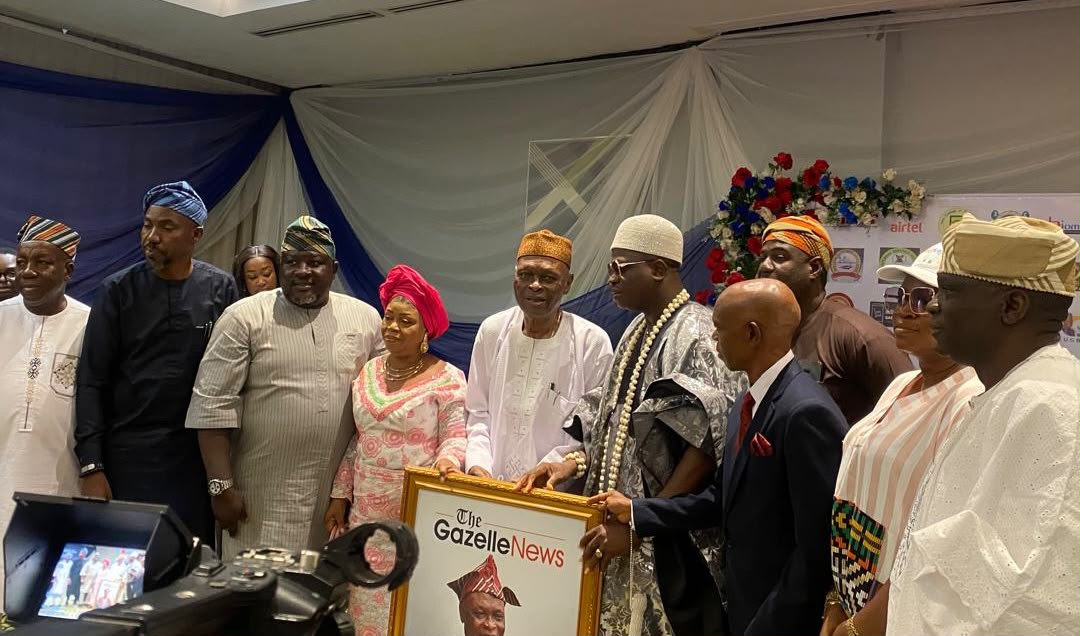
By Fisayo Balogun.
Stakeholders from government, the media, and the private sector on Wednesday called for stronger collaboration between public institutions and private organizations to drive sustainable grassroots development in Nigeria.
The call was made at The Gazelle News Annual Public Lecture and Awards 2026, held at the Radisson Blu Hotel, GRA, Ikeja, Lagos, under the theme, “Driving Grassroots Governance with Public-Private Partnership: The Gains, The Pains, The Prospects.”
The event began with the rendition of the Nigerian National Anthem, followed by the welcome of guests by the event anchors, Oluwatomisin Adebukola and Mr. Ladega.
In his opening remarks, Mr. Musibau Rasak welcomed participants and highlighted the significance of the annual lecture in promoting dialogue on national development and governance.
Delivering remarks on behalf of the Chairman, Dr. Kadri Obafemi Hamzat, Senator Musiliu Obanikoro stressed the importance of collaboration between government and the private sector in fostering sustainable development, particularly at the grassroots level.
The keynote lecture was delivered by Chief Sunday Alin Dare, who described local governments as the foundation of national development, arguing that true progress should be measured by the quality of education, healthcare, roads, neighborhood safety, and opportunities available to young people.
“True development is not measured by architectural marvels. It is measured by the quality of primary schools, the condition of roads, the stability of healthcare, the safety of neighborhoods, and the opportunities available to our youth,” Dare said.
Speaking on recent reforms, Dare described local government autonomy as a significant milestone in Nigeria’s democratic journey, noting that it provides councils with greater capacity to plan, attract investment, and deliver services directly to communities.
He, however, cautioned that autonomy alone would not guarantee development unless accompanied by transparency, accountability, effective service delivery, and meaningful partnerships with communities and the private sector.
Dare also identified weak institutional capacity, policy inconsistency, transparency gaps, political transitions, and declining public trust as major obstacles to successful public-private partnerships at the local government level.
To address these challenges, he proposed strengthening local government institutions through capacity building, establishing transparent procurement frameworks, promoting community participation, leveraging technology for accountability, and measuring governance by improvements in citizens’ quality of life.