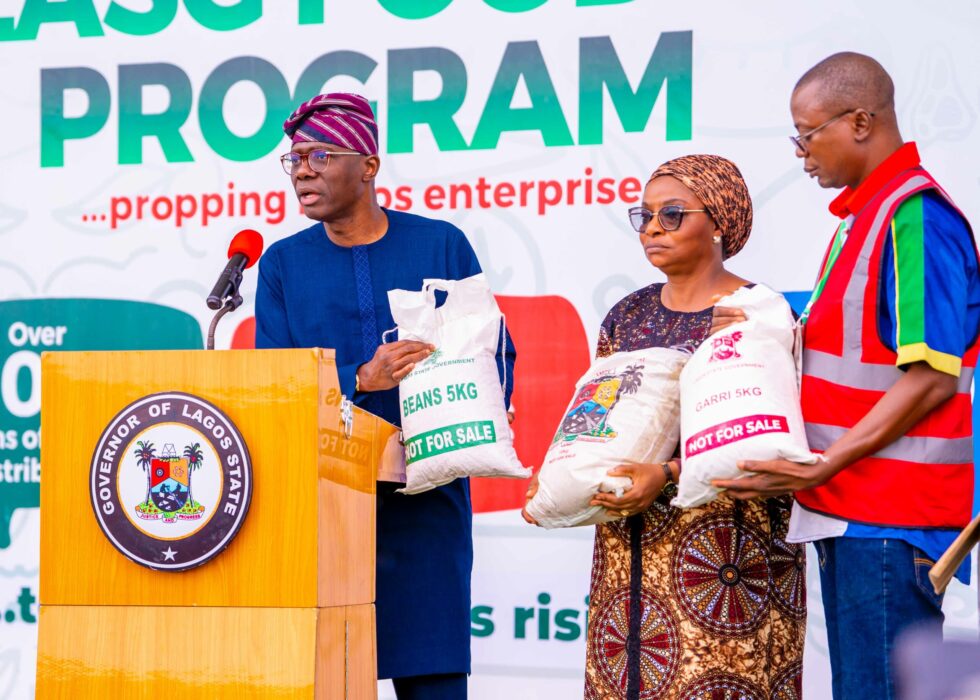
The distribution of palliatives in many parts of the country has been characterised by stampede, and in some cases, leading to the deaths of a sizable number of citizens.
But in Lagos State, it has so far been seamless, a feat Gov. Babajide Sanwo-Olu attributed to careful planning and stakeholders’ engagement, among others.
Sanwo-Olu said the distribution of food items to vulnerable households was carried out through groups, institutions, non-governmental organisations, community development committees, and associations of people living with disabilities.
He said the distribution was also done through the Social Protection Department in the Ministry of Economic Planning and Budget, using the social register of vulnerable people in the state.
Sanwo-Olu said to ensure transparency in the implementation of this intervention, a Monitoring Committee was constituted.
The members were drawn from religious groups, trade unions, people with disabilities, civil society and non-governmental organisations, youth groups, community development councils, and representatives of the Lagos State House of Assembly.
The distribution was phased among the various beneficiary groups for ease of the distribution process. In line with this plan, each group was duly informed of the date of collection.
Sanwo-Olu, on Sept. 3, 2023, flagged off the Lagos Food Bank Programme to distribute food to 500,000 households to cushion the impact of fuel subsidy removal and the harsh economic situation in the country.
The governor said over 2,500 micro, small, and medium enterprises (MSMEs) were involved in bag manufacturing, food aggregation, packaging, and logistics as part of the programme, while over 25,000 employees of the MSMEs would be indirectly impacted.
He said the strategy was to reach 500,000 vulnerable households in the state with staple food items using two methodologies: bulk food items (50kg of rice, 50kg of garri, and 100kg of beans) for groups and food boxes (10kg of rice, 5kg of garri, and 5kg of beans) for individual vulnerable households.
Mr. Ibrahim Farinloye, Lagos Territorial Coordinator, National Emergency Management Agency (NEMA), also underscored the importance of planning and stakeholders’ engagement in the distribution of palliatives.
He told the News Agency of Nigeria (NAN) on Wednesday in Lagos that his organisation engaged security personnel in all the steps involving the distribution of palliatives.
“In all situations, we included security: at least an area commander and not less than five divisional police offices and their teams.
“We ensure that the space to be used is big and open enough, surrounded by strong barriers that are mounted by staff of NEMA and not by the Nigeria Police Force,” Farinloye said.
He said that before the day of distribution, the agency held expanded meetings with the different stakeholders.
“First, we compile lists of all impacted members of the community, followed by sensitization on what we intend to do and how it would impact the beneficiaries.
“Working with community stakeholders like the Community Development Area, traditional rulers, and political office holders and politicians within the area, we identify volatile areas in the community and give PEP talks on how the community could help us to assist them.
“Our Option B is emergency preparedness for the exercise,” Fainloye said.
According to him, the agency takes into consideration the weather conditions and changes in temperature within the season and factors them into its plans.
He said if the distribution was carried out during the dry season, for instance, it would consider that some people would suffer exhaustion, thereby putting in place plans to forestall it.
“We carry out pre-assessment studies on hospital holdings, putting into consideration that some of the beneficiaries could be hypertensive,” Farinloye said.
He said during the distribution proper, bulk SMS and printed tickets would be sent to beneficiaries to ensure that they were attended to in an orderly manner.
Farinloye said the palliatives or materials to be distributed had also been tagged to correspond with the tickets of the beneficiaries.
Dr. Femi Oke, Chairman, All Farmers Association of Nigeria (AFAN), Lagos State Chapter, and South-West Zone, urged other state governments to set up palliative implementation and distribution committees like Lagos State did to prevent stampede.
Oke told Nan that it was sad that some people suffered life-threatening injuries and even death because of the basic necessities of life.
He said the distribution process was poorly executed in some states, so there was no way the issue of stampede could not have occurred because many people were hungry.
He pointed out the single incident of stampede in Lagos when the Nigeria Customs couldn’t coordinate the sale of rice on its premises.
“It was a sad incident for us to hear that people died while trying to benefit from government palliatives due to a lack of proper coordination.
“I was expecting every state government or state governor to inaugurate a committee that would oversee the distribution of palliatives,” he said.
He advised state governments to partner with associations, especially the registered ones, artisans, traditional rulers, market men, and women, for the even distribution of palliatives.
He said it was not a bad idea for the government to share palliatives, but that all tiers of government should channel their resources into providing inputs and machinery to farmers to boost food production. (NAN)