Kaduna, Jan. 27, 2026(NAN) A civic space dialogue, organised by Civic Impact for Sustainable Development Foundation has examined strategies for integrating a Digital–Green Twin Transition into Kaduna state’s ongoing youth policy review.
The dialogue, held on Monday in Kaduna, had the theme ‘Harnessing Kaduna’s Demographic Dividend, Mainstreaming the Digital-Green Twin Transition into the State Youths Policy’.
Yusuf Goje, Executive Director of Civic Impact, presented an overview of the youth policy review, describing Kaduna’s youth bulge as a strategic economic opportunity.
He recalled that the 2021–2025 youths policy identified Kaduna as a demographic crossroads, with population projections reaching 12.9 million by 2030.
Goje said 43 per cent of the population being under age 15 positions youth as the future workforce driving economic expansion.
He stated that current realities remain challenging, citing 35 per cent unemployment among youths aged 15–35.
Goje added that nearly 60 per cent of youths aged 15–24 were classified as Not in Education, Employment, or Training (NEET).
He stressed that females constituted 54.6 per cent of the youth population, demanding deliberate gender-responsive interventions.
Goje highlighted health concerns, including only 17.6 per cent of deliveries occurring in health facilities and just three youth-friendly health centres statewide.
He explained that the policy’s five pillars aligned with the Kaduna State Development Plan, covering workforce productivity, health and social welfare, participation, protection, and partnerships.
Goje said the policy categorised youths into low-risk, especially vulnerable groups, and most-at-risk segments to ensure inclusive interventions.
He outlined implementation plans anchored on a multi-sectoral coordination framework involving ministries, schools of technology, private hubs, and civil society.
Goje identified gaps in the existing policy, noting ICT and environmental sustainability are treated as separate, limiting green-tech job creation.
He said digital skills training remains confined to office software, while environmental action is reduced to conservation and waste management.
Goje proposed integrating green-tech roles, including data analytics for climate-smart agriculture and IoT for smart energy systems.
He stressed that digital transition cannot succeed without power, and green transition cannot scale without digital monitoring.
Goje called for solar-powered digital hubs to address rural digital exclusion and reduce carbon footprints.
He lamented the absence of youths-focused climate finance, proposing a Twin Transition Venture Fund for digital climate solutions.
Goje said the policy review must address the “triple divide” affecting women across gender, digital, and climate dimensions.
He advocated explicit quotas for women in agri-tech and green innovation programmes.
Goje described the Digital–Green Twin Transition as a shift toward a knowledge-based economy integrating digitalisation and sustainability.
He said the review would introduce virtual skills hubs, data-driven youth governance, AI literacy, and remote work readiness.
Earlier, the Kaduna State Commissioner for Youths Development, Gloria Ibrahim, said youths inclusion remains central to effective governance.
She thanked civil society organisations for facilitating dialogue that amplifies youth voices in policymaking.
Ibrahim said the Ministry of Youths Development was created to correct years of youth exclusion from policies affecting them.
She said many policies predated the ministry and lacked meaningful youth input.
Ibrahim stressed that policies must become actionable plans owned and implemented by youths.
She lamented poor awareness of frameworks like the Demographic Dividend Roadmap among young people.
Ibrahim said the ministry was working to improve policy awareness and practical implementation at community level.
She highlighted partnerships with some financial organisations which provide grants and support for youth-led MSMEs.
Ibrahim said government investments in technology hubs and green transport would promote legitimate wealth creation.
She urged youths to reject complacency and take responsibility for governance outcomes.
At a panel discussion the Founder of Ihifix Technologies, Mr Emmanuel Adikpe called for a dedicated digital youth chapter in the revised policy.
He criticised outdated digital skills definitions, urging recognition of tech hubs as formal skills partners.
Adikpe said skills acquisition must reflect evolving labour markets rather than traditional trades alone.
He argued climate action must be economically viable to remain sustainable.
Adikpe urged programmes that link digital innovation and green enterprises to long-term income generation.
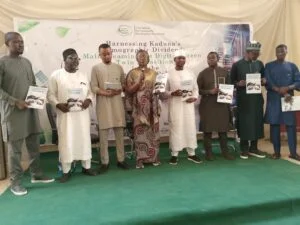
The News Agency of Nigeria (NAN) reports that the event, brought together government officials, civil society actors, technologists, and youth leaders to shape evidence-based policy reforms.
High point of the event was the dissemination of simplified version of
Kaduna state Demographic Dividend
Roadmap (2024) and presentation of
awards to development partners.
The awardees included FCDO-Lafiya and PACE Programmes, among others.
The dialogue, was supported by; FCDO-Lafiya and PACE Programmes, Ihifix Technologies, Procyon Radio and TV, Barnseed, and the Youth Advocacy Coalition on Demographic Dividends Roadmap (YACDDR)
It was also supported by the Institute of Budget Policy, Leapman Legal, Youth and Community Development Initiative Kaduna and the Ministry of Youth Development, among others.(NAN)