

The Food and Agriculture Organization (FAO) has intensified efforts to promote deforestation-free finance in Nigeria, with focus on cocoa and oil palm production in the Niger Delta region.
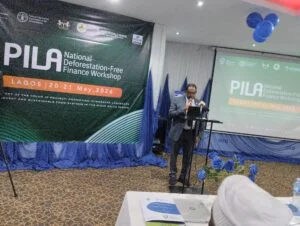
The News Agency of Nigeria (NAN) reports that the two-day workshop began in Lagos on Wednesday with the theme: “Advancing Deforestation-Free Finance in Nigeria’s Banking Sector: From Roadmap to Implementation.”
The workshop is being held under the Global Environment Facility (GEF-7) Food Systems, Land Use and Restoration (FOLUR) Impact Programme, funded by the Global Environment Facility and implemented by FAO in collaboration with national partners.
The programme promotes integrated landscape management, sustainable food systems, biodiversity conservation and restoration of degraded ecosystems in key commodity landscapes, especially cocoa and oil palm.
Speaking at the opening, the FAO Representative in Nigeria and to the Economic Community of West African States (ECOWAS), Dr Hussein Gadain, described the workshop as a critical step from dialogue to implementation.
Gadain said agriculture, trade, investment and environmental sustainability were becoming increasingly interconnected globally, with financial institutions playing a key role in determining how agricultural commodities are produced and financed.
According to him, Nigeria, as one of Africa’s leading producers of cocoa and oil palm, has a unique opportunity to align agricultural growth with environmental sustainability.
“Nigeria remains one of Africa’s leading producers of cocoa and oil palm, sectors that contribute significantly to livelihoods, food security, employment and economic development.
“However, agricultural expansion continues to place increasing pressure on forests, biodiversity and ecosystems,” he said.
Gadain said FAO would continue to support Nigeria through technical assistance, policy support, capacity building and multi-stakeholder engagement.
He expressed confidence that Nigeria could emerge as a regional leader in sustainable and deforestation-free agricultural finance.
According to him, financial institutions can shape land-use practices and commodity production through lending policies, investment frameworks, risk management systems and sustainability standards.
He noted that global trends were shifting toward sustainable banking frameworks, Environmental, Social and Governance risk management, sustainability-linked lending and climate-informed investment decisions.
Gadain said the Nigerian Sustainable Banking Principles established by the Central Bank of Nigeria provided a strong foundation for advancing responsible finance.
He said participants would review the policy and regulatory environment, findings from a national financial sector scoping study, and global best practices in traceability and accountability.
Gadain stressed that deforestation-free finance was not only an environmental necessity but also an economic and market imperative, as global buyers and investors increasingly demand sustainable supply chains.
He added that smallholder farmers, women, youth, cooperatives and small and medium-scale enterprises (SMEs) must be included in the transition.
“Financial innovation must be accessible, affordable, scalable and responsive to local realities,” he said.
Also speaking, the Director-General of the Forestry Research Institute of Nigeria (FRIN), Dr Zacharia Yaduma, said the workshop underscored the urgent need to translate policy commitments into practical financing solutions.
Yaduma said Nigeria must pursue agricultural expansion, economic development and environmental sustainability simultaneously.
He noted that while institutions such as FRIN generate knowledge for sustainable forest management, decisions made by financial institutions and policymakers are equally critical to land-use outcomes.
“The transition to deforestation-free production systems is no longer optional; it is becoming a global standard,” he said.
Yaduma said access to international markets, climate finance and investment capital was increasingly tied to sustainability performance, traceability and environmental responsibility.
He said that although the Nigerian Sustainable Banking Principles offered a solid framework, more practical financial instruments were needed to support farmers, SMEs and agribusinesses.
“Without sustainable financing, even the most well-designed land-use strategies risk remaining theoretical,” he said.
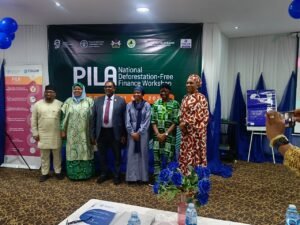
Participants at the workshop included representatives of the Central Bank of Nigeria, the Federal Ministry of Agriculture and Food Security, the Federal Ministry of Environment, National Task Force on the European Union Deforestation Regulation, FRIN and the European Union Delegation. (NAN)


