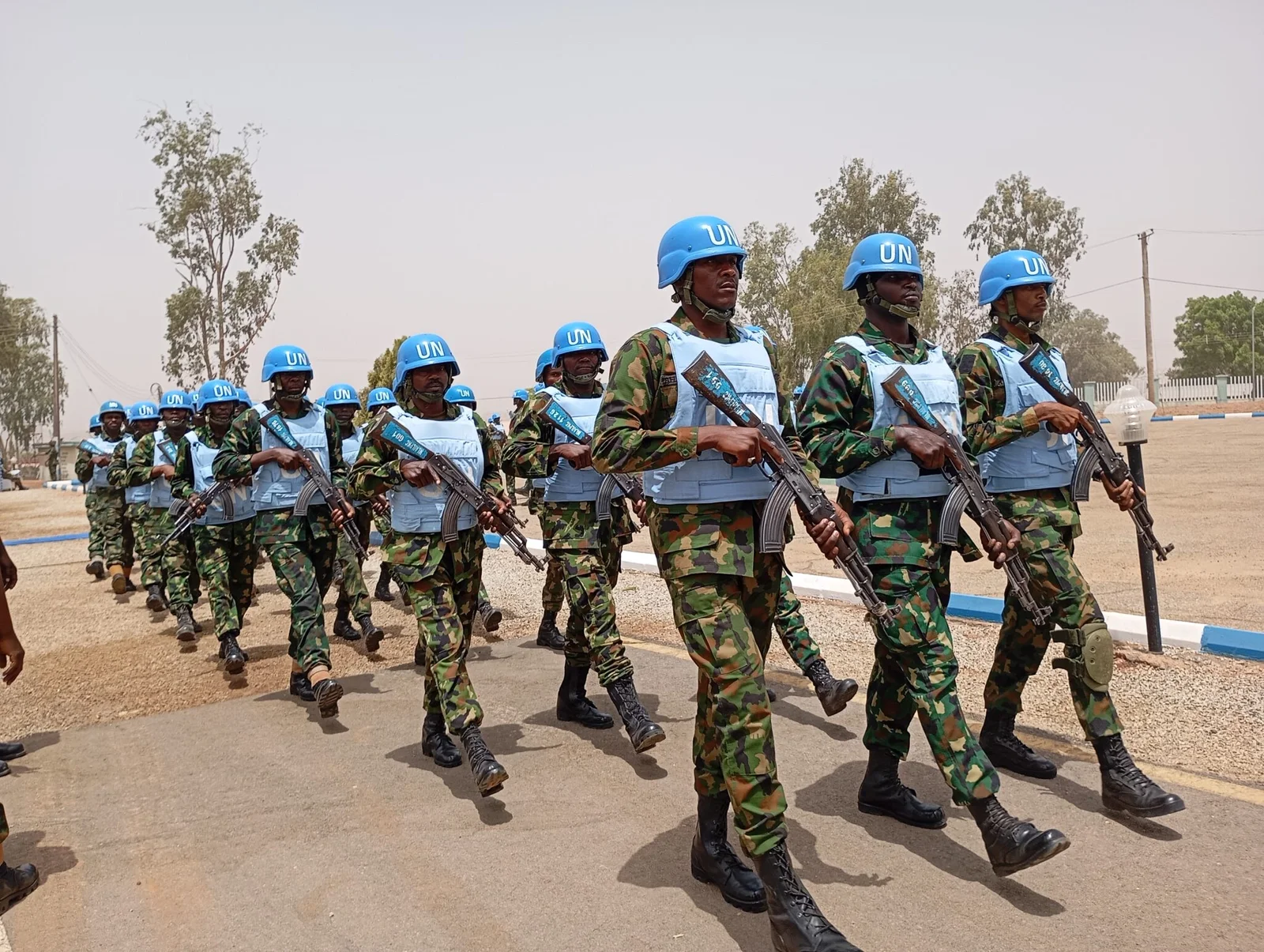
The Martin Luther Agwai International Leadership and Peacekeeping Center, on Wednesday, rounded off the training of 157 Army troops deployed for a peacekeeping mission to Abyei in South Sudan.
The News Agency of Nigeria (NAN) reports that the troops, primarily from Nigerian Company 2 to the United Nations Interim Security Force in Abyei (NIGCOY 2 UNISFA), consisted of 15 officers and 142 soldiers.
Maj.-Gen. Boniface Sinjen, the Chief of Operations, Army Headquarters, addressed the troops at their pre-deployment graduation ceremony.
Sinjen said the occasion demonstrated the commitment and capacity of the Armed Forces of Nigeria to deploy quality peacekeepers as part of its contributions to global peace and security.
According to him, Nigeria’s national defense policy remains focused on the security and stability of Africa, with specific emphasis on the West African sub-region.
He said that Nigeria continued to seek global peace and security by contributing to and participating in peace support operations around the world.
To this end, Singen said Nigeria had successfully participated in over 40 peacekeeping missions and had deployed more than 100,000 peacekeepers since her first mission in the Congo in 1960.
“All Nigerian peacekeepers, alongside others from around the world, have aided the course of humanity while helping nations in distress restore peace and enthrone much-desired development.
“The UNISFA was established to restore peace and stability in Abyei after the demilitarisation of Abyei in June 2011, making it an administrative town under the control of the United Nations.
“Essentially, the mission is mandated to protect civilians under imminent threat of physical violence, protect the area from incursions by unauthorised elements, and ensure security.
“The mission has also helped to restore peace and stability in Abyei through the professional conduct of the troops, he said.
He urged the contingent to shun acts such as sexual exploitation, abuse, and other mission misconduct capable of tarnishing the image of Nigeria.
Singen also mandated that they always be guided by the rules of engagement while observing human rights and respecting diversity in the operating environment.
Earlier, the Commandant of MLAILPKC, Maj.-Gen. Ademola Adedoja, said the unit began the 6-week pre-deployment training on January 27, 2024.
He said the pre-deployment training was to equip the earmarked unit with the requisite skills and knowledge to function effectively and efficiently in their deployment to Abyei.
Adedoja said that as part of the training, the troops were taken through cross-cutting issues like sexual exploitation and abuse, conflict-related sexual violence, conduct and discipline, as well as the protection of civilians, amongst others.
The commandant stressed that Nigeria had, since the 1960’s, contributed troops to different peace support operations in the Congo, Yugoslavia, and Lebanon, amongst others.
He said, “As the powerhouse of the West Africa sub-region, Nigeria has committed both human and material resources to the attainment of peace in the sub-region.
“This graduation is a testament to the capacity and capability of the MLAILPKC as a United Nations-accredited center to train quality peacekeepers for deployment to multidimensional peace support operations in fulfillment of her mandate.
“The centre has within the last six weeks been able to train, retrain, and refresh the troops on the requisite knowledge and expertise to succeed in a peace support operational environment.
“It is my fervent belief that these men are better informed and equipped to perform their roles in Abyei.”
The commandant tasked the troops to carry out their duties bearing in mind the multinational as well as the cultural and religious diversities of the operating environment, which underscored the need for courtesy and respect for others.
He cautioned them against involving themselves in the trafficking of illicit substances, stressing that the UN and ECOWAS maintained a zero-tolerance policy on sexual exploitation and abuse (SEA).
“The Armed Forces of Nigeria and indeed the Nigerian Government will not tolerate the contravention of these rules and regulations, he said.
Adedoja thanked the Chief of Army Staff for his strategic guidance and immeasurable support to the centre, which he said had brought about the successful completion of the pre-deployment training.(NAN)