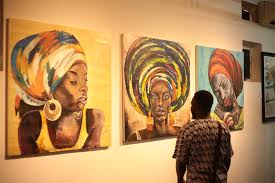
For a growing number of Nigerian visual artists, the white walls of galleries are no longer enough.
They belief that art must move beyond display and become a framework for dialogue, preservation and measurable support.
Abdulrazaq Ahmed, Dr Omawumi Kola-Lawal, and Dr Moses Oghagbon are among the artists who share this philosophy, quietly shaping their creative practice.
Though their themes differ — from cultural festivals to Almajiri children and environmental justice — their conviction is strikingly similar. Art, they insist, must function as social infrastructure.
For Ahmed, whose 2022 to 2023 solo exhibition ‘KNOWMADS’ at the Centre for Contemporary Art, Lagos, highlighted the lives of Almajiri children, the past few years have brought visibility and institutional interest.
His large-scale mixed-media works isolates everyday symbols; plastic bowls and wooden writing tablets, placing the children against stark backgrounds to examine their daily existence without distraction.
Ahmed believes awareness alone is no longer sufficient.
He described the period between 2022 and 2025 as one of growing international attention.
He, however, is determined that recognition should translate into systems that benefit the communities he documents.
“The gains from 2022 to 2025 are the increased international attention and the proven interest from institutions.
“In 2026, the plan is to convert that attention into actionable local projects and to build systems that allow the work to fund tangible support,” he said.
Central to this shift is a proposed pilot programme in a northern Nigerian city, where Almajiri children will participate in guided art-making sessions at least twice weekly.
“The goal is not to make them artists but to use the process as a form of routine, cognitive engagement and emotional expression they often lack,” he said.
Ahmed is also developing a digital archive titled, ‘The Street is a Classroom’, which will pair images with anonymized audio snippets of the children’s voices.
This, he says, shifts the narrative from his interpretation to a more direct, though carefully curated, presentation of their reality.
To ensure sustainability, Ahmed plans ethical commercial collaborations, where adapted motifs from workshop drawings can appear on limited-edition items, with a guaranteed percentage funding feeding programmes, medical support and formal Almajiri centres.
He also intends to convene an annual artist-led forum bringing together photographers, visual artists and filmmakers, who focus on street-connected children globally, to share methods and address ethical pitfalls.
For him, exhibitions are only the starting line.
For Oghagbon, whose recent exhibitions include ‘Borderless Border’ in Kigali and ‘Deconstructing Unity’ at the National Museum, Lagos, the past year offered both reflection and clarity.
“The past year has been a period of consolidation and reflection for my practice.
“Exhibiting internationally has not only expanded the visibility of my work but has also strengthened my understanding of how cultural narratives from Nigeria resonate within global contexts,” he said.
His work, which documents landscapes, festivals and lived traditions, is rooted in cultural continuity.
Yet, he is careful to emphasise that gallery exposure is not the ultimate goal.
“Exhibitions are entry points, not endpoints.
“By combining exhibitions with documentation, storytelling, and dialogue-driven initiatives, my goal is to ensure that visual art functions not only as aesthetic expression but also as an active contributor to cultural understanding and continuity,” he said.
Oghagbon embarked on a documentation road trip this February to Kebbi State to capture the Argungu International Fishing and Cultural Festival, the Rigata Annual Cultural Festival and activities across the emirates of Argungu, Yauri and Zuru.
He plans to feed the documentation into his forthcoming solo exhibition, ‘ARGUNGU SERIES 11’.
Beyond exhibitions, Oghagbon is deepening collaborations with cultural institutions, tourism boards and community-based organisations.
He also plans artist talks, workshops and interdisciplinary conversations involving historians and scholars.
“I am particularly interested in creating spaces where art becomes a medium for listening, where audiences do not only view works but also engage with the stories, questions, and histories behind them,” he said.
For him, art must serve as an archive and a bridge, connecting generations and safeguarding fragile cultural memory.
Kola-Lawal sees the broader shift taking place across the arts sector.
“One of the most significant gains I’ve seen has been the growing recognition of art as a tool for social and environmental dialogue, not just aesthetic expression.
“I’ve seen both appreciation of skill and beauty, as well as an increased interest in thematic, purpose-driven work, particularly art that speaks to sustainability, justice, and lived social realities.
“My focus for 2026 is to build on this momentum by showing more of my artworks, in collaboration with various partners,” she said.
Kola-Lawal plans to develop projects that integrate community participation and environmental consciousness, using exhibitions and creative platforms not only to showcase work but to spark learning, dialogue and collective ownership of social issues.
From their contributions, a consistent philosophy emerges: art must listen, collaborate, document and influence.
Their recommendations converge on structured community programmes, digital archives, sustainable funding loops, artist residencies, policy engagement and global conversations through virtual platforms.
For these artists, the gallery wall is no longer a boundary but a doorway.
What lies beyond it, they suggest, is where the real work of art begins. (NANFeatures)