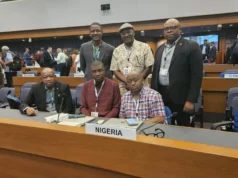
A team of researchers from the University of Nigeria, Nsukka, has advised South-East governors to domesticate the Disability Act 2018 without further delay.
The team leader, Prof. Uzoma Okoye, gave the advice on Tuesday at a workshop organized for disability stakeholders in the zone to create awareness about the Act.
She said that only Anambra had domesticated the Act, while the other four had yet to do so.
“The aim of this workshop is to create awareness as well as tell Imo, Abia, Enugu and Ebonyi states to domesticate the Act.
“This is to ensure that when the Act takes effect in 2024, its implementation will not experience obstacles in the zone.
“We are grateful to Anambra Government for domesticating the Act and urge the remaining states to do the same before 2024,” Okoye said.
She said the team sent a proposal to the Africa Polling Institute (API) to sponsor a research on the challenges facing People With Disability (PWD) in the zone.
She said the workshop provided the opportunity for them to discuss the team’s findings.
“In the five states of the zone, only Anambra has domesticated the Act.
“Others have not even sent the bill to their Houses of Assembly talk more of domesticating it,” she said.
She said the research reveals that PWD in the zone did not have good access to a lot of things, including public buildings, and were being discriminated against.
“Some of them, especially those on wheelchairs, cannot access public buildings, offices and residential houses because their interest was not considered when the structures were built.
“In spite the fact that the implementation of the Act will start in 2024, when public buildings, structures and automobile, among others, are to be modified for access and use by persons with disabilities, there are no attempts to modify these structures in the zone,” she said.
Uzoma urged civil society organizations (CSOs), rights activists and other groups to help in promoting awareness about the Act so that PWDs would get the required relief from it.
“They should also help to mount pressure on Imo, Enugu, Abia and Ebonyi states to domestic the act before the commencement of its implementation,” she said.
The Chairman of the workshop, Prof. Michael Okolie, commended the organizers and urged states in the zone to do the needful to ease the plight of PWD.
Okolie expressed concern that most times government hurriedly signs a bill into law but usually fail to put measures in place for its implementation.
“The Disability Act is to take effect from January 2024 but nothing has been modified in public places, such as banks, secretariats, tertiary institutions, markets, shopping plaza to make them accessible to PWD,” he said.
The don, however, urged the organizers of the workshop not to concentrate only on people with physical disability.
“As you are treating the issue of those who are physically disabled, also consider those who are psychologically impaired.
“It appears why things are not going the way they should in Africa may be because we are either physically or psychologically disabled,” Okolie said.
In an interview with the News Agency of Nigeria (NAN), some of the PWD stakeholders at the workshop thanked the organizers for having the interest of PWD in the zone at heart.
They requested that similar workshops to create awareness about government policies and programmes concerning them should be made more regular.
They also urged the researchers, CSOs and other groups to continue to put pressure on states that had yet to domesticate the Act to urgently do so.
(NAN)