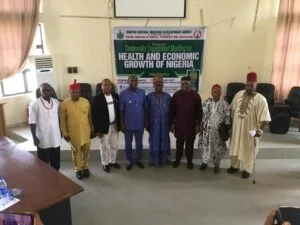
Prof. Martins Emeje, Director-General, Nigeria Natural Medicine Development Agency (NNMDA), has expressed displeasure over Nigeria’s over-dependence on the importation of drugs and other healthcare products.
Emeje expressed his displeasure at a Community Engagement for Health and Economic Growth of Nigeria held on Saturday at the Nnamdi Azikiwe University (NAU), Awka, Anambra.
The engagement, organised in collaboration with the Federal Ministry of Science, Technology, and Innovation, was tagged “Importance of Integrating Indigenous Medicine with Orthodox Health Practices for Community Health and Economic Development.”.
Emeje said that no fewer than 160 million Nigerians could afford the imported drugs, describing the situation as painful and shameful.
According to him, Nigeria is insecure in terms of medicine.
“Nigeria and Africa have been overly dependent on the importation of healthcare products, including drugs. That is why we decided to develop our own indigenous and natural medicine so we could produce our drugs locally.
“We are naturally endowed with diverse plants, animals, and other untapped bio-resources that we can convert into our own medicine.
“Over 40 percent of drugs in the pharmaceutical space globally are from plant origin, not to mention animals, minerals, and soil.
“For every disease, the solution is within the environment. There is no disease in Nigeria for which the panacea is not here,” he said.
The Director-General said the people of old who depended on cultural practices and traditional medicines lived for over 100 years.
Emeje said there was a need to recognise the herbal and traditional medical practitioners with a wealth of knowledge and experience on how to tackle all manner of diseases in our society.
“Today, life expectancy is less than 60 years because we have thrown away our culture and heritage and are busy exporting and exploiting our own cultural bio-diversity and depending on imported pharmaceuticals
“The predictions of an increase in mortality rate in Nigeria and Africa during COVID-19 did not come true because of our abundant bio-diversity, especially of plant origin.
“Nature has endowed us with combination therapy, which we must harness,” he said.
Emeje said that the agency had plans to establish research farms in all 774 local government areas in the country as well as herbal clinics in all states.
He said that the research farms would be meant for integrated cultivation, medical production, and functional foods, among others.
According to him, the research farm at Kano State is 90 percent complete, while that of Plateau and Cross River States just commenced.
“This engagement is part of a research project involving five countries: China, India, the United Kingdom, Uganda, and Nigeria.
“These countries are collaborating to find solutions to the problem of antimicrobial use using herbal medicine of Nigerian origin.
“My agency is leading Nnamdi Azikiwe University and Obafemi Awolowo University with Prof. Charles Esimone and Prof. Ibrahim Bello as part of Nigeria’s team to develop this medicine,” he said.
Also speaking, Prof. Charles Esimone, Vice Chancellor, NAU, said the engagement was targeted at harvesting indigenous knowledge of medical plants for affordable, sustainable, and acceptable healthcare.
Esimone said he was optimistic that the engagement would end with a position paper to ensure healthcare needs and resources are identified and harnessed.
He said that, as a proud pharmacist, he was passionate about solving healthcare problems using the country’s indigenous knowledge.
He said Nigeria is a big country to overlook, especially in the area of healthcare provision, and we have a comparative advantage in terms of natural medicine.
“We also have very rich, but untapped, biodiversity. Regrettably, our traditional healers with enormous endowments are going to their graves with those endowments.
“Universities are supposed to provide policy direction based on empirical research they have done.
“NAU has a track record in terms of research in pharmaceuticals, with a correspondingly strong pharmaceutical faculty and extensive collaboration nationally and internationally.
In his remarks, Mr. Louis Madubuattah, Anambra State Coordinator, National Agency for Food and Drug Administration and Control, promised that the agency would support the project.
He said that NAFDAC would support the project in addressing the challenges of clinical trials and product certification for marketing.
He also called for visibility and collaboration on the part of herbal medicine practitioners, as well as the need to seek grants and investors to combat the challenge of anti-microbial resistance.
On his part, Chief Hyacinth Ezeugo, Chairman, Anambra State Traditional Medicine Practitioners Association, canvassed for a traditional medicine hospital in each state of the federation.
“We are the professors who are going to hand over to the next generation. But we have been struggling to succeed, and we are praying that one day traditional medicine will be recognised.
“But I think that time has come, and we cannot afford to miss this opportunity,” he added.(NAN)