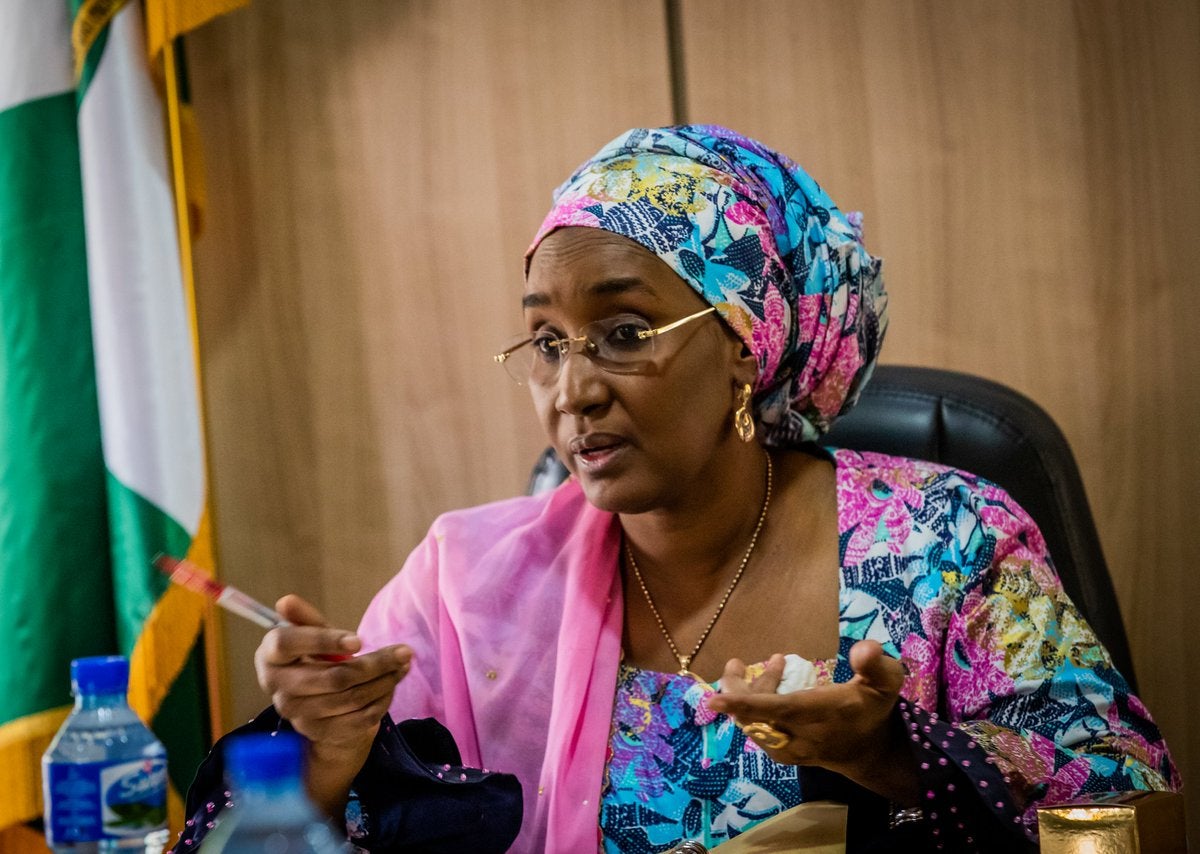
The Minister of Humanitarian Affairs, Disaster Management and Social Development, Hajia Sadiya Umar Farouq, has solicited the cooperation and supports of more partners to effectively address the prevailing humanitarian challenges in the country.
Farouq made the appeal while discussing the Social Development and Humanitarian Challenges Facing Nigeria and Federal Government’s Responses to Humanitarian and Food Crises in the country at a Chatham House Webinar, hosted by Dr Leena Koni Hoffman.
This is contained in a statement by Mrs Nneka Anibeze, the Special Assistant on Media to Farouq, on Wednesday in Abuja.
Farouq thanked the UN system in Nigeria and other donor agencies, including development partners that have significantly assisted in addressing the prevailing humanitarian challenges in the country.
She added that the ministry needed more partners to key into existing policies to address the crises.
“The Ministry is now desirous of partners to key into existing programmes, policies and structures to address the prevailing humanitarian challenges.
“By that, I mean, more collectively, planning and agenda-shaping in a coordinated and sustained manner for better impact.
“We are also passionately appealing for cooperation and support in measuring and assessing impact of all these activities and investment for the purposes of building better safety-net tools and ultimately achieving sustainable development.
“The Federal government, through the Ministry, is clearly committed and has established effective coordination platforms to facilitate this,” Farouq said.
The Minister noted that the food security challenges in the Northeast is a sore point following the volatile situation in the region.
She, however, says that the Ministry is consistently working with humanitarian stakeholders and the Military to facilitate humanitarian access and promote accountability in the humanitarian space within the Civil-Security Framework and coordination platform.
“The recently approved National IDP Policy provides leadership and guidance framework towards food security for the North-East region and promotes minimum standards and thresholds to tackle ongoing displacement until a durable solution is established for the IDPs.
“On a practical level, the Federal Government, through the National Emergency Management Agency (NEMA), provides rationed food items to IDPs in the Northeast, especially in Borno State.
“In addition, state governments and other Ministries Departments and Agencies also channel food through the Ministry or directly to IDPs.
“The Ministry works closely with humanitarian and development partners, also providing food assistance support to ensure it is delivered in a coordinated manner through our Food and Nutrition Working Group,” she said.
She added that her Ministry was also involved in Cadre Harmonised assessments that monitor, study and analyze trends in order to prescribe sensitive food ration interventions.
“It is my fervent hope and that of the Ministry that an effective technical, operational and financial cooperation and support from the UN will significantly contribute towards the effective realization of the Ministry’s twin objectives of achieving effective coordination and impactful implementation of its programmes in a sustainable manner”. (NAN)