Lagos, Jan. 30, 2026 (NAN) Abdulrazaq Ahmed, a Nigerian visual artist, has unveiled an initiative aimed at addressing long-standing policy and welfare gaps affecting Almajiri and other street-connected children.
Ahmed, whose work has drawn international attention since 2022, told the News Agency of Nigeria (NAN) on Friday in Lagos that he would use art as both an advocacy tool and a pathway to structured support.
Drawing from experiences of exhibitions such as “KNOWMADS” at the Centre for Contemporary Art, Lagos, and group shows in Kaduna and Lagos, Ahmed said the gains from 2022 to 2025 have created a responsibility to act locally.
He said the focus of the new phase was to move beyond awareness, rising to interventions that directly respond to the daily realities of underserved children.
“In 2026, my focus is on moving from raising awareness to creating direct, structured support and expanding the reach of the conversation through new platforms and partnerships.
“The plan is to convert that attention into actionable local projects and to build systems that allow the work to fund tangible support,” he said.
He said one of the key components of the initiative was a pilot programme to be launched by Abdulrazaqstudio, in a northern Nigerian city, to be announced in the future.
He said the programme would offer a secure space where Almajiri children could participate in guided art-making sessions at least twice a week.
Ahmed said it would be in collaboration with local NGOs and child-welfare experts.
“The goal is not to make them artists but to use the process as a form of routine, cognitive engagement and emotional expression they often lack,” he said.
He noted that many street-connected children were caught between informal religious education, economic hardship and weak social protection systems, leaving them excluded from policy planning and support services.
Ahmed said he planned to strengthen advocacy and documentation by converting his 2025 works into an open-access digital archive titled, ‘The Street is a Classroom’.
He said the platform would combine images with anonymised audio recordings of children speaking about their daily experiences, hopes or their observations.
“This shifts the narrative from my interpretation to a more direct, though carefully curated, presentation of their reality,” he said.
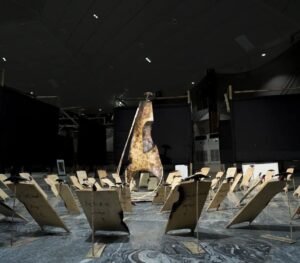
He said the initiative also included digital exhibitions to widen public engagement and feed into policy conversations beyond Nigeria.
Ahmed further said that as part of efforts to create sustainable support systems, he was pursuing collaborations with ethical fashion brands to adapt motifs from children’s drawings into limited-edition products.
According to him, a guaranteed percentage of each sale would be directed to established formal Almajiri centres, feeding programmes or medical funds for the featured communities.
Ahmed said this model would respond to a broader challenge facing socially engaged art, which is the absence of funding structures that benefit the communities being represented.
He said he also planned to convene an annual artist-led forum in Lagos or Abuja, bringing together artists, filmmakers and photographers working with street-connected children globally to share methods and address ethical concerns.
The artist said the forum would complement interdisciplinary panels, community forums and virtual conferences designed to bring artists, educators, social workers and policymakers into the same conversation.
“By collaborating with local and national policymakers, I aim to bring artistic narratives into policy discussions,” he said.
He added that artworks and white papers would also be used to highlight gaps and propose solutions.
He expressed hope that sustained engagement between artists, communities and policymakers would help reposition Almajiri and street children not as statistics but as voices that deserve to shape the policies. (NAN)