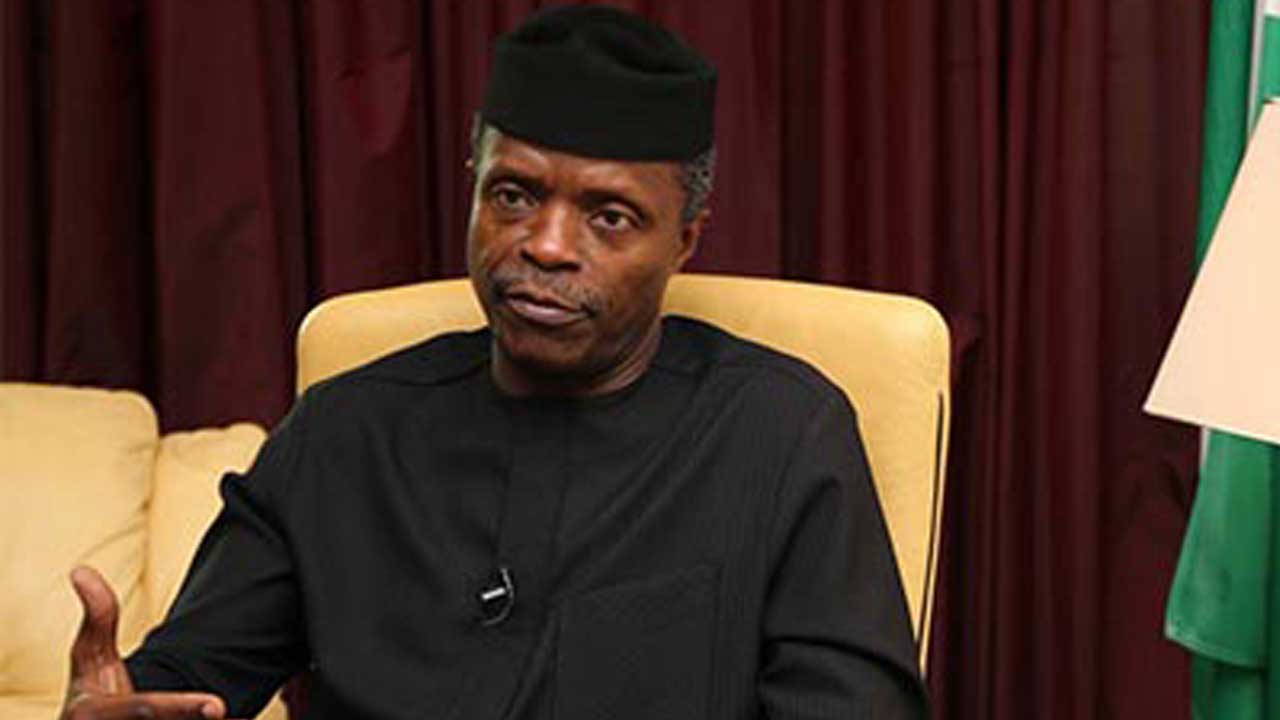
Vice President Yemi Osinbajo says Nigeria’s young generation can find solutions to present and future local and global challenges, with the right ideas, innovation and application of technology.
The vice president said that the Federal Government’s National Development Plan 2021-2025 was aimed at charting a path for the county’s future.
Osinbajo’s spokesman, Laolu Akande, in a statement in Abuja, said the vice president spoke at the 60th anniversary of the Obafemi Awolowo University (OAU), Ile-Ife, Osun.
He told the graduands that the future belonged to them and urged them to pay attention to it.
The vice president, who was the Special Guest of Honour at the convocation ceremony, stood in for President Muhammadu Buhari as Visitor, and was accompanied by Gov. Gboyega Oyetola.
Gov. Rotimi Akeredolu of Ondo State delivered the Convocation Lecture at the event presided over by the Etsu Nupe, Alhaji Yahaya Abubakar, as Chancellor of the University.
Osinbajo said that while young Nigerians, particularly the OAU graduands, stood on the shoulders of great men and women before them, the onus was on their generation to deal with the biggest issues that confronted the world and Nigeria.
“And it is big and innovative ideas that will solve those problems; you will have to confront the problems of climate change and a world moving away from fossil fuels, and you will usher in the age of renewable energy and green solutions.
“Yes, the challenges are huge, but you are well equipped to resolve them; and the evidence is there; since 2016, in spite of two recessions, young Nigerians have built six unicorns; a unicorn is a company that is valued at over a billion dollars.
“You will deal with the issues of feeding, educating, providing healthcare and jobs for the fourth largest population in the world in a few decades.
“We will need smarter agric solutions to feed the huge numbers, technology is already helping to crowd-fund Agriculture and develop more prolific seedlings.
“You will confront the need to vastly improve our public and clinical healthcare; we must build on the work of the Genomic Centre at Ede, and the local vaccine production efforts going on already and make local drugs for hundreds of millions of Nigerians.”
In education, Osinbajo said that the sector needed several new solutions, including designing methods to teach millions even outside of classrooms.
According to him, there are many young men and women already doing great things using technology to reach children in far flung areas with education.
The vice president added that the use of technology and improvement in nationwide policing would further help the country address its security challenges.
“The insecurity problems we are experiencing, the rise of terrorism in several parts of this large country and access to modern weaponry by non-state actors tell us that we must be smarter in policing the country, using smart drones and surveillance equipment.
“The politicisation of importation of arms tells us that we must manufacture our own arms.
“Already Proforce, led by Ade Ogundeyin, is manufacturing APCs and MRAPS in their factory in Ode Remo and exporting.
“So are Imperium, and the government-owned DICON (Defence Industries Corporation of Nigeria) producing different types of munitions.
“The future is smart weapons benefiting from Artificial Intelligence and machine learning.”
Osinbajo praised the vision of the university’s founders and management in driving the academic excellence for which OAU was known for–an institution, which he said had produced great thinkers and leaders throughout its history.
According to Osinbajo, OAU is and continues to be very much a bastion of progressivism and innovation.
“And not surprisingly you will find the phrase ‘Aluta against all oppression’ in the Great Ife anthem.
“This progressivism is evident in the outlook of staff and students alike,” he said.
Present at the convocation were eminent Nigerians, government dignitaries, top officials, traditional rulers, academics, staff and students.
Afterwards, OAU’s Vice Chancellor, Prof. Eyitayo Ogunbodede, conducted the vice president and other dignitaries around an arts exhibition to commemorate the event.(NAN)