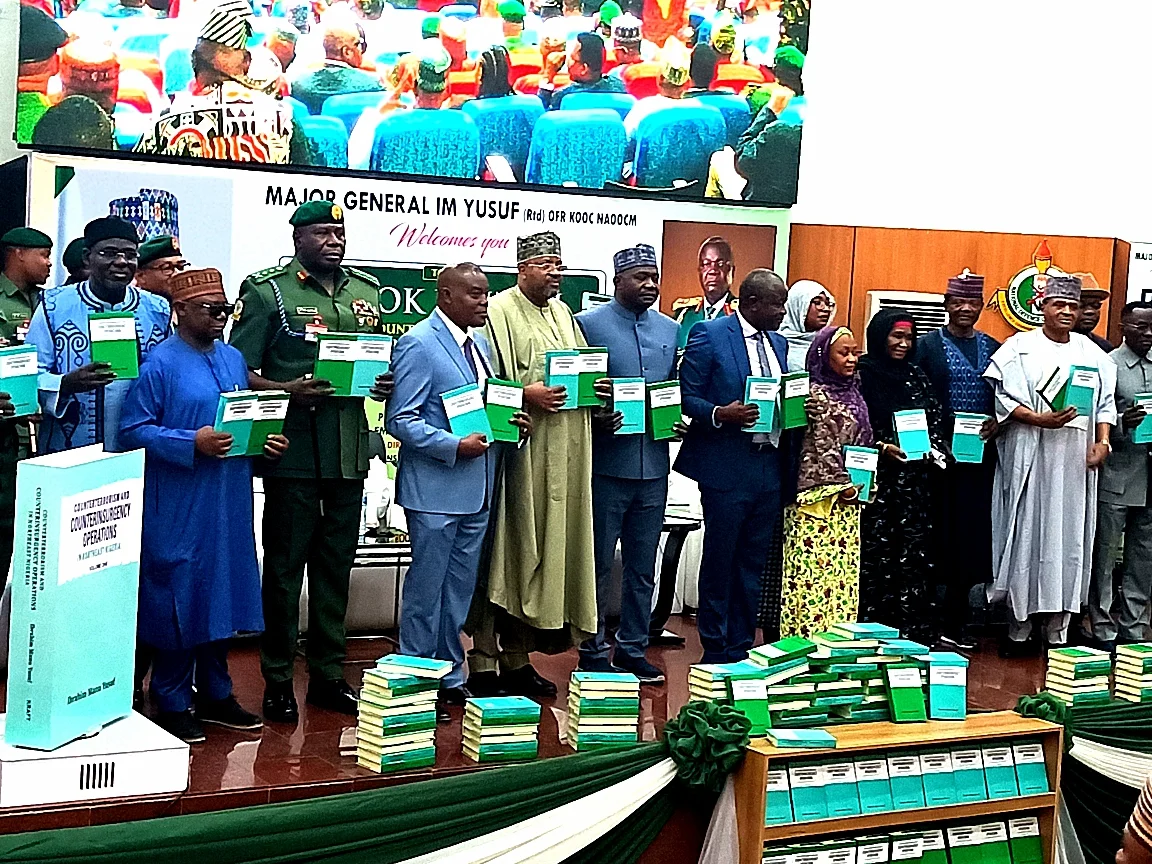
A retired Nigerian Army General, Maj.-Gen. Ibrahim Yusuf, has unveiled a two-volume book on counter-terrorism operations in North East Nigeria.
Yusuf also called on senior military officers to document their operational experiences for future generations.
Speaking at the unveiling of “Counter-terrorism and Counter-insurgency Operations in North East Nigeria (Volumes 1 & 2)” in Abuja on Thursday, he said that writing the book was more demanding than leading troops in the field.
”I must confess that writing a book is far more demanding than leading men into battle. It is easier to command troops than to document experiences in a scholarly manner,” he said.
He said the publication, which took about eight years to complete, was driven by the need to contribute to professional military knowledge and guide younger officers engaged in counter-insurgency operations.
He also said he deliberately avoided sensitive operational details that could compromise ongoing missions, stressing that the book focused on lessons learned and strategic reflections from over a decade of field experience in the North-East and Lake Chad Basin.
According to him, the work is intended to bridge existing gaps in Nigeria’s counter-terrorism literature and support policy formulation, operational planning, and military education.
Yusuf urged retired officers to document their experiences, noting that institutional memory was critical to improving future operations and strengthening the Armed Forces.
”By doing so, we contribute to institutional memory, national development, and the continuous improvement of our Armed Forces,” he said.
The book reviewer, Prof. Eghosa Osaghae, described the work as a landmark contribution to military scholarship and a practical guide for counter-terrorism operations in Nigeria.
Osaghae noted that the volumes spanning about 900 pages, provided a comprehensive analysis of counter-insurgency and counter-terrorism operations, blending theory with practical command experience.
He said the book situates Nigeria’s experience within global ”new war” dynamics and highlights the evolution of military responses through theatre commands, joint task forces, intelligence-driven operations, and civil-military engagement.
Osaghae added that intelligence remains the ”currency” of counterinsurgency, stressing the importance of reliable, validated, and human-centred intelligence in asymmetric warfare.
He however, noted that certain sensitive operational details were deliberately excluded due to ongoing security considerations, and recommended the book as essential reading for military professionals, policymakers, and researchers.
In his goodwill message, former Chief of Army Staff, retired Lt.-Gen. Tukur Buratai, said the publication clearly captured both the successes and challenges of counter-insurgency operations, but stressed that the real story of the conflict lay in the quality of leadership in the field.
Buratai noted that operational success depended largely on competent commanders who understood their responsibilities and were willing to lead from the front.
He addded that success in complex operations was achieved not by directives alone, but by translating strategic intent into decisive field action.
”Success in such complex operations is not achieved by directives alone, but by ensuring that capable hands are available to translate strategic intent into operational action on the ground,” Buratai said.
He noted that operations such as Deep Punch I and Deep Punch II were products of adaptive leadership, courage, and inter-service coordination, adding that air-ground cooperation between 2015 and 2017 significantly contributed to degrading terrorist capabilities in the North-East.
He also recalled instances where troops were cut off during operations and commanders had to take decisive actions under difficult conditions, stressing that such experiences underscored the realities of field command and the importance of resilience and leadership at all levels.
According to him, one key lesson from the counter-insurgency campaign is that success requires both strong military coordination and the active cooperation of the population, without which lasting victory against insurgency remains difficult.
Buratai commended the author for documenting operational experiences and urged serving and retired officers to contribute to military literature to strengthen institutional memory and doctrine development.
Earlier the author acknowledged the support of Vice President Kashim Shettima during his tenure as governor of Borno, as well as the Federal Government, military leadership, and stakeholders in the security sector.
He also expressed appreciation to stakeholders, including the Vice President, represented at the event; the Minister of Defence; the Chief of Defence Staff; Service Chiefs; former service chiefs; security agency heads; academics; and members of his family.(NAN)