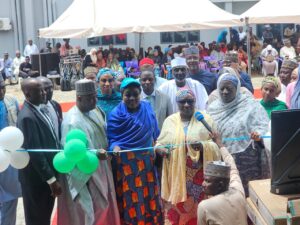
The Kaduna State Government has equipped selected primary healthcare facilities with equipment and consumables to improve services for mothers, children and adolescents.
The News Agency of Nigeria (NAN) reports that the intervention was supported by Global Affairs Canada (GAC), through the United Nations Children’s Fund (UNICEF).
The equipment included motorbikes, orthopaedic chairs, public address systems, refrigerators, smart televisions, adult weighing scales, plastic chairs, blood pressure apparatus, among other essential items.
Speaking at the event on Tuesday, the Deputy Governor of Kaduna State, Dr Hadiza Balarabe, said the intervention demonstrated what could be achieved when government and development partners worked together towards a common goal.
Balarabe said the Kaduna government remained committed to ensuring quality healthcare regardless of age, gender, location or economic circumstances.
The deputy governor appreciated the Canadian Government through Global Affairs Canada, UNICEF and Gates Foundation for their continued partnership with Kaduna State.
She said adolescents and young people constituted an important segment of the population whose health needs should not be treated as an afterthought.
According to her, the establishment and equipping of safe spaces will provide adolescents with health information, counselling and services in supportive and non-judgmental environments.
She said the initiative would empower young people to make informed decisions and adopt healthy behaviors that would contribute to their wellbeing.
Balarabe said maternal, newborn and child health remained central to the state’s commitment to improving health outcomes.
She said every mother deserved quality care during pregnancy, childbirth and after delivery, while every newborn deserved the best possible start in life.
The deputy governor said every child also deserved timely and appropriate healthcare, stressing the importance of functional equipment and essential consumables.
She said the availability of appropriate equipment, combined with competent and motivated health workers, would help prevent complications, provide timely interventions and save lives.
Balarabe said the state government recognized that a strong, functional and resilient health system was fundamental to Kaduna’s development and prosperity.
She said health remained a priority under the administration’s SUSTAIN manifesto, with at least 15 per cent of the state budget allocated to the sector.
The deputy governor urged beneficiary facilities to ensure effective utilization, proper maintenance, accountability and sustainability of the equipment and consumables.
She said the success of the intervention would be measured by improved care for women, newborns, children, adolescents and young people.
Balarabe urged health workers to treat patients with dignity, compassion and professionalism, stressing that quality interaction was equally important.
She appealed to communities to support primary healthcare facilities and encourage pregnant women to attend antenatal care and deliver under skilled health professionals.
She also urged communities to seek timely healthcare for sick newborns and children and encourage adolescents to access accurate health information.
Earlier, the Kaduna State Commissioner for Health, Hajiya Umma Ahmed, said the intervention represented another milestone in efforts to strengthen the health system.
Ahmed said the state government, under Sani’s leadership, remained committed to transforming primary healthcare and bringing quality services closer to residents.
She said the transformation went beyond infrastructure improvement to ensuring that primary healthcare centres were functional, equipped and adequately staffed.
The commissioner said adolescent health safe spaces would provide young people with health information, counselling and essential services in safe, confidential and youth-friendly environments.
She urged managers of beneficiary facilities to ensure proper utilization of the equipment and commodities for their intended purposes.
Ahmed also called on parents, guardians, community and religious leaders, schools and other stakeholders to support adolescents in accessing appropriate health information and services.
She said investing in the health of young people was an investment in the future of Kaduna State.
Ahmed said the intervention formed part of the broader transformation of primary healthcare, including the revitalization of 255 primary healthcare centres.
The Executive Secretary of the Kaduna State Primary Healthcare Board, Prof. Bello Jamoh, appreciated UNICEF and Global Affairs Canada for the timely intervention.
Jamoh said the equipment would help bridge identified gaps in primary healthcare facilities and improve the availability of adolescent-friendly and maternal, newborn and child health services.
He stressed that the value of the intervention would depend on proper distribution, utilization and maintenance of the equipment and commodities.
Jamoh reaffirmed the board’s commitment to working with UNICEF, Global Affairs Canada and other development partners to achieve the intervention’s objectives.
He said the board would ensure that no adolescent, young person, pregnant woman, newborn or child was denied quality healthcare because of inadequate equipment.
The UNICEF Chief of Field Office in Kaduna, Dr Gerida Birukila, said Kaduna was among three states benefiting from Global Affairs Canada support for adolescent reproductive health.
Birukila said the other beneficiary states were Bauchi and Kebbi, adding that Kaduna had demonstrated strong ownership and commitment to strengthening health systems.
She said adolescents aged 10 to 19 constituted a significant proportion of the population and required specific health interventions.
According to her, prioritizing health services, information, education and life skills would empower adolescents, particularly girls, to make informed decisions.
Birukila urged stakeholders to listen to young people, remove barriers to healthcare and create spaces where they could grow in confidence and dignity.
She said Kaduna was estimated to have more than four million adolescents, making investment in their health particularly important.
Birukila said adolescent health was critical because important milestones in human development, including maternal and mental health, occurred during the adolescent years.
Speaking on behalf of development partners, Dr Anthony Shamang of Gates Foundation, thanked the Kaduna Government for creating an enabling environment for health interventions.
Shamang said the launch of adolescent health corners and distribution of maternal, newborn and child health commodities marked a significant step towards improving health outcomes.
He said the health corners would provide safe spaces where young people could access vital health information and services.
Shamang said the maternal, newborn and child health commodities would help mothers and newborns receive critical care during vulnerable periods.
He urged stakeholders to ensure effective utilization of the resources and ensure that they reached those who needed them most.(NAN).