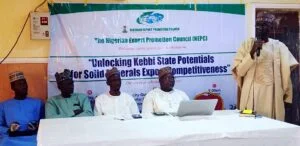
The Nigerian Export Promotion Council (NEPC) has said that the Kebbi’s 30 identified mineral deposits were critical to diversifying Nigeria’s economy and reducing dependence on oil exports.
The Executive Director and Chief Executive Officer of NEPC, Mrs Nonye Ayeni, disclosed this at the training of more than 70 artisanal miners and stakeholders in Birniin Kebbi on Thursday.
The News Agency of Nigeria (NAN) reports that the training is on strategies to enhance the competitiveness of solid minerals exports, as part of efforts to diversify Nigeria’s non-oil export base.
NAN reports that the capacity-building programme, titled “Unlocking Kebbi State Potentials for Solid Minerals Export Competitiveness,” was held in Birnin Kebbi.
It brought together government officials, mining operators, investors, development partners, and representatives of relevant agencies.
Ayeni, who was represented by the Kebbi Coordinator of NEPC, Alhaji Muhammad Sirajo-DanAlkali, disclosed that Kebbi hosts about 30 identified mineral deposits, including lithium in Libata, gold, copper, and gypsum, which have strong export potential.
She added that the state also possesses substantial deposits of iron ore in Gwandu, limestone in Jega, bauxite in Suru and Dandi, as well as coal in Birnin Kebbi.
According to her, these resources can support industrial development, create jobs, and generate significant export revenues if properly harnessed.
The NEPC boss said Nigeria must leverage its abundant solid mineral resources to boost non-oil export earnings and reduce dependence on crude oil.
Ayeni described the state’s vast mineral deposits as one of Nigeria’s most promising export frontiers.
She noted that the global transition to clean energy, digital technologies, and advanced manufacturing had significantly increased demand for critical minerals worldwide.
According to her, the International Energy Agency projects that demand for transition-critical minerals will grow by more than 400 per cent by 2040.
“Nigeria possesses the minerals the world needs. The challenge before us is whether we are prepared to harness and deliver these resources competitively and sustainably,” she said.
The CEO explained that the council was promoting mineral export clusters, investor linkages, and value-chain development through its Solid Minerals Directorate.
She said the council’s “Double Your Export” campaign was designed to increase the volume and value of Nigeria’s non-oil exports through product diversification, quality assurance, and expanded market access.
Ayeni stressed the need to move away from the export of raw and unprocessed mineral ores to value-added products capable of attracting premium prices in international markets.
“The era of exporting raw minerals must give way to processing, beneficiation, and value addition. Engineers, metallurgists, and materials scientists are critical drivers of this transformation,” she said.
She also recalled that the 16th National Council on Commerce, Trade and Investment held in Lagos in May 2025 approved the inclusion of solid minerals under the One State, One Product (OSOP) initiative.
The NEPC boss noted that the resolution was intended to deepen participation of ministries, agencies, and operators in the solid minerals value chain within state export promotion committees.
She urged the state’s stakeholders to accelerate the selection of solid minerals as the state’s OSOP product and embrace export registration, cluster formation, and value addition to unlock emerging opportunities in the sector.
Earlier, the Chairman of the occasion and Kebbi Coordinator of the National Environmental Standards and Regulations Enforcement Agency (NESREA), Alhaji Nasiru Hussaini, described the workshop as a critical step towards transforming the state’s mineral resources into economic prosperity.
Hussaini said Kebbi was endowed with valuable minerals, including gold in Fakai and Ngaski, kaolin in Zuru, limestone in Argungu, as well as quartz, mica, feldspar, and iron ore deposits spread across various local government areas.
He, however, noted that in spite of the abundance of resources, the state had yet to fully maximise the economic benefits due to limited value addition and processing activities.
“Our objective is to move Kebbi from merely possessing mineral resources to becoming a competitive exporter of value-added solid minerals capable of creating jobs, increasing internally generated revenue, and developing host communities,” he said.
The NESREA coordinator emphasised the importance of partnerships among government institutions, investors, local communities, and development partners in building a sustainable mining industry.
He assured prospective investors that Kebbi remained open to responsible investment capable of generating employment opportunities, increasing revenue, and promoting environmental sustainability.
NAN reports that participants were also sensitised on quality standards and certification requirements for international markets.
A paper titled “Driving Export Competitiveness in the Solid Minerals Sector through Standardisation, Conformity Assessment and Certification: The Role of Standards Organisation of Nigeria (SON)” was presented on behalf of SON by its Coordinator in Kebbi, Alhaji Abubakar Kabiru-Shagari.
The presentation highlighted the importance of adherence to standards, quality assurance, and certification in enhancing the competitiveness of Nigerian solid minerals in global markets. (NAN)