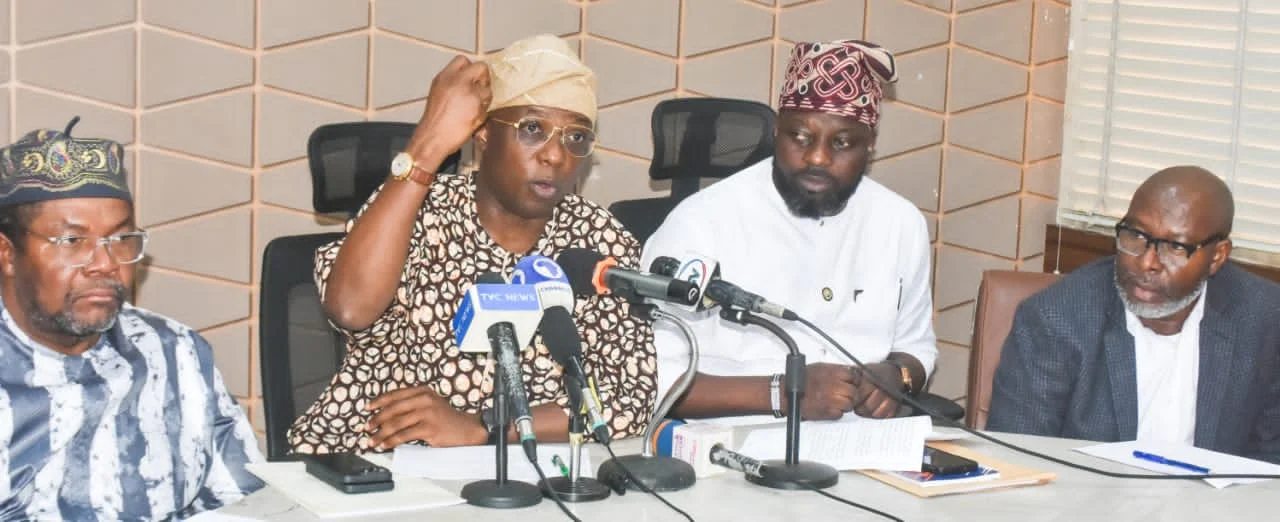
Mr. Tokunbo Wahab, Commissioner for Environment and Water Resources, Lagos State, says the state is expected to experience abnormal rainfall in 2024, with a total of 1936.2 mm of predicted rainfall.
Wahab said this at a news conference on 2024 Seasonal Climate Predictions (SCP) and socio-economic implications for Lagos State on Tuesday.
Wahab said the average annual rainfall predicted for 2024 was 1936.2 mm, which was greater than the long-term average of 1721.48 mm, with the onset date expected to be the first week of April and ceasing in the first week of December.
According to him, Ikeja is expected to have an onset date of April 4 and a cessation date of December 4, with a high annual amount of 1900 mm of rainfall.
He said Badagry would have a rainfall onset date of April 1 and a cessation date of December 5, resulting in an annual amount of 1978 mm.
He added that Ikorodu was expected to have a rainfall onset date of April 4 and a cessation date of December 4, totaling an annual amount of 1903 mm.
He said Lagos Island would have a rainfall onset date of April 3, a cessation date of December 4, and an annual amount of 1936 mm.
Epe is expected to have a rainfall onset date of April 2, a cessation date of December 5, and an annual amount of 1952 mm.
According to him, below-normal rainfall is anticipated in the first half of the rainy season, while normal to above-normal rainfall is expected in the second half of the rainy season.
He said the Ministry’s collaboration with NiMet on seasonal climate prediction had been valuable as a vital weather and early warning tool for farmers, decision-makers, operators of the various sectors, and businesses likely to be impacted by the annual rainfall.
He said the government had plans to downscale the seasonal climate prediction for stakeholders and emergency workers in the state.
He added that the state had deployed and maintained its network of weather stations and river gauge stations to monitor the weather and river levels in the state and increase its preparedness for weather and flood-related issues.
“We want to assure you that our state will continue to reap the benefits of careful and rigorous execution planning as our flood control measures are stepped up to contain any imminent rainfall.
“The Ministry has embarked on an all-year-round drainage maintenance programme for effective and efficient flood control, in addition to an efficient and sustainable solid waste management system,” Wahab said.
He noted that to effectively contain flooding in the state, the government was determined to maintain synergy and partnership with the Ogun-Oshun River Basin Authority (OORBDA).
He added that the rainfall from neighbouring Ogun, Oyo, and Osun states, dam releases, and river water levels in the state would also be monitored.
He said the partnership ensured control and monitoring of the steady and systemic release of water from Oyan Dam to prevent flooding as it reached the Ogun River.
He said the relationship had been highly beneficial and would be sustained.
He said proactively, the state had strengthened the Flood Early Warning Systems (FEWS) to deliver reliable, timely, and effective flood information at an appropriate response time.
He added that the low-lying Agiliti, Agboyi, Itowolo, and Ajegunle communities would be closely monitored with respect to the likelihood of Ogun River flooding, as well as all other river basins in the state.
The Commissioner explained that it was expected that the high amounts of rainfall and other contributory factors might lead to flooding in some parts of the state and that this might lead to a rise in Lagoon level.
He explained that anytime there was high tidal movement, it could “lock up” the discharge points of drainage channels, and until it receded, there would be no discharge.
He said such occurrences could cause backflow, resulting in flooding, and as soon as the lagoon receded, all the generated storm water would immediately be discharged and the roads would be free.
He stressed that it was only when storm water remained on the roads for hours that there should be reports of food.
He emphasised that the government had put all emergency response organisations, traffic management organisations, and other emergency-related organisations on high alert to help lessen the effects of thunderstorms and associated rains in the state.
He maintained that the government would ramp up sensitization for residents along the flood plains of major rivers such as Owode, Iwaya, Makoko, Badia, Ijora, Isaalu, Pota, and Shibiri to be ready to relocate to higher grounds when the need arose.
He said drainage engineers were available in all 57 local government areas and local council development areas to attend to drainage-related matters during and after the rainy season.
Also speaking, the Special Adviser on Environment, Mr. Olakunle Rotimi-Akodu, appealed to residents to support the efforts of the government through regular cleaning of drains to ensure free flow of storm water as well as desist from dumping refuse into drainage channels.
He added that residents should refrain from acts that could lead to flooding, such as indiscriminate dumping of construction materials, erecting building structures within and around drainage right-of-way, and setbacks.
He also advised residents to report cases of drainage blockages, dumping of waste into canals, and other unauthorised places to the residents engineers and zero-tolerance offices statewide.
He urged motorists to observe prescribed speed limits on the roads to avoid losing lives and property during the rainy season.
“Residents should always do more environmental maintenance and support,” Rotimi-Akidu said. (NAN)