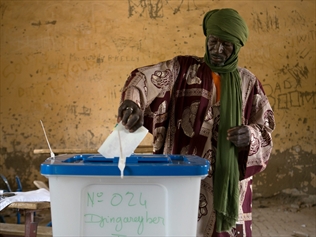
 Mali cheered the robust turnout and lack of violence in its high-stakes election on Monday as proof Malians were eager to turn the page on more than a year of turmoil, war and army coup.
Election officials were still counting ballots on Monday and results are not expected until Tuesday, but local newspapers lauded the vote, with state-run L’Essor saying the turnout was “exceptional”.
“There were women, old people, blind people. Everyone wanted to vote,” said Mariam Diallo-Drame, a youth leader who had encouraged people to take part in the election.
“This is the first time ever we have a truly democratic election. We have never seen that in Mali…We understood what happens if we don’t fulfill our obligations. People are saying it is now up to the politicians to understand,” she said.
Gamer Dicko, a spokesman at the Interior Ministry, which organised the vote, said it would take time to transport the results sheets across the country, which is twice the size of France, and collate them.
The vote was the first since a coup in March last year led to the occupation of Mali’s north by separatist and Islamist rebels.
French forces intervened in January to defeat the al Qaeda-linked fighters, whose threats to disrupt the election did not materialise.
However, the candidates are known and few expect the kind of radical overhaul of Mali’s political class that many say is necessary.
APEM, a network of local observers, said 87 per cent of the reports from the 1,587 polling stations where it had a presence concluded that the voting process had been satisfactory.
There were some 21,000 polling stations across Mali.
Turnout at some polling stations visited by Reuters on Sunday was more than 50 per cent, while participation in previous presidential elections has never exceeded 40 per cent.
Chief EU observer Louis Michel said on Monday the election took place in a calm atmosphere and also said participation exceeded 50 per cent in some places.
“No major incidents were reported even though there were some imperfections,” Michel told newsmen in Bamako.
“But none of these incidents, none of these imperfections could jeopardise the legitimacy of the results,” he said.
In a few examples of the problems, some Malians had difficulty finding the right polling station, and thousands who were displaced by the conflict are likely to have missed the vote as they would not have received the newly-printed ID cards.
Voting in Kidal, the heart of the Tuareg rebellion in Mali’s desert north that sparked the crisis last year, was muted, observers and residents said.
The future president must still secure a long-term peace with separatist rebels.
Observers said there were some protests against the vote in Kidal and a UN source said Tuareg MNLA rebels had sought to prevent some people from voting in Menaka, another northern town.
Results were meant to be posted outside all polling stations after local counting was completed, but they were missing from most locations visited in Bamako by Reuters on Monday morning.