Mixed reactions greeted the reintroduction of the monthly environmental sanitation exercise in Lagos State on Saturday, as many residents complied with movement restrictions but recorded limited participation in cleanup activities.
The Lagos State Government recently reinstated the exercise, scheduled for the last Saturday of every month between 6:30 a.m. and 8:30 a.m., as part of efforts to promote a cleaner and healthier environment.
Commercial activities were largely suspended across parts of the state as residents observed the restriction order. However, active participation in sanitation efforts remained low in several communities.
Correspondents of the News Agency of Nigeria (NAN), who monitored the exercise in Iyana-Ipaja and Alaguntan/Alimosho areas, observed that shops and businesses remained closed in compliance with government directives.
While some residents cleaned their surroundings, many stayed indoors throughout the exercise.
In spite of the restriction, a few food vendors operated within the Iyana-Ipaja market and nearby motor parks, selling to travelers and passengers waiting for movement restrictions to be lifted.

At several parks in Iyana-Ipaja, commuters were seen waiting patiently to continue their journeys, while some had already boarded buses ahead of the reopening of roads.
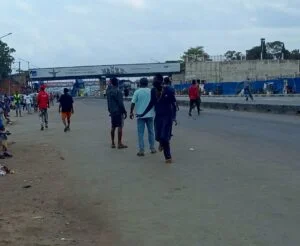
The usually busy Lagos-Abeokuta Expressway at Iyana-Ipaja appeared unusually quiet, with only minimal activity recorded. Some youths, however, took advantage of the reduced traffic to play football on the road.
Most residents remained indoors, with only a handful observed clearing gutters and cleaning their immediate surroundings.
Officials of the BRT monitoring and enforcement team were deployed to ensure compliance and maintain order.
Speaking with NAN, an Iyana-Ipaja resident, Mr Biodun Oni, described environmental sanitation as beneficial, noting that regular cleanup exercises would reduce waste buildup and blocked drainage systems.
According to him, this would help prevent flooding and curb diseases such as cholera and malaria.
“They also create a sense of shared responsibility among residents, especially when communities actively participate rather than comply out of obligation,” he said.
The exercise, though successful in enforcing restricted movement, underscored the need for stronger public participation to achieve lasting environmental impact.
A resident of Apatira Street in Alaguntan/Alimosho, popularly known as Mama Apa, said residents should embrace the exercise as a civic duty.
“The government has directed us to clean our environment, and as law-abiding citizens, we should comply.
“As you can see, I called out the male tenants in my compound to clear gutters and weed the surroundings.
“We are doing what is expected, even though many residents in the area refused to come out,” she said.
Another resident, Mr Oriafo Edo, described the sanitation exercise as a positive initiative but said residents would need time to adapt.
“The sanitation exercise appears compulsory to many people. As you can see, only a few residents came out to participate.
“It will take time for people to get used to it. Some residents already employ cleaners to maintain their compounds.
“I believe the government should focus more on gradual sensitisation rather than immediate sanctions,” he said.
A resident who requested anonymity said she was unaware of the exercise until she encountered warnings while heading out.
“I was not aware of the sanitation exercise and had already left home.
“After hearing warnings on the streets and noticing the absence of commercial motorcycles, I decided to return home.
“The government needs to intensify awareness campaigns on this monthly exercise,” she said.
Another resident, Mr John Adeola, said environmental cleanliness should be a personal responsibility rather than one driven solely by regulation.
“I clean my environment regularly without needing a government directive.
“Most people stayed indoors because they feared sanctions rather than participating in cleanup activities.
“The government should intensify sensitisation to encourage voluntary compliance,” he said.
In the Agodo/Egbe area of Alimosho, rainfall between 6:30 a.m. and 7:00 a.m. further reduced participation, as no residents were seen engaging in cleanup activities.
Only skeletal commercial motorcycle operations were observed, while in Ikotun, buses still picked passengers heading to Oshodi and Cele Express. Some youths and adults were also seen loitering in parts of the area.(NAN)