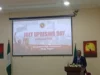
Panelists at the 2021 Future of Health Conference(FHC), highlighting challenges for women journalists in Nigeria, say there is the need to foster connections and solidarity among women in the media in the country.
They said this at a two-day event of the 2021 FHC, with focus on amplifying gender discourse, organized by Nigeria Health Watch (NHC), and themed “Breaking Glass Ceilings: Gender Equality For Sustainable Development.”
The News Agency of Nigeria (NAN) reports that the 2021 FHC is the seventh in the series, a platform where policymakers, healthcare professionals and development partners meet to deliberate on the challenges in the Nigerian health sector, and collectively develop potential solutions that are actionable, sustainable and impactful.
According to NHW, the glass ceiling refers to the invisible barrier preventing women from ascending to leadership roles. This barrier can exist through both subtle and direct discrimination.
The glass ceiling continues to symbolize the enduring barriers faced by women in the workplace, in their local communities and in the larger society.
The panelists for the “Women in Media” session, explored women’s representation in media and the impact on sustainable development, according to Mr. Chris Obosi, CEO of Megalectrics Limited, believed there should be a gender balance in the media, most especially in Nigeria.
Obosi, who is also of the Classic FM 97.3, Beat 99.9FM and Naija FM 102.7, said that there had been a sharp rise in women representation in media across board in the last 10 years in the country.
“This is a welcome development in addressing the issues of gender equality in our country.
“Female journalists are better at investigative reporting than men,” he said. “We should be encouraging them,”.
“People relate better with people that walk in their shoes. Women stories by women have a positive impact on our ability to reach the audience,” he said.
Ms. Biola Alabi, an award-winning executive producer and founder of Biola Alabi Media, said “If women do not have the right representation in the media, it would be difficult to address the issues of sexual and reproductive health and gender equality in our society.
Alabi, who is also a pan-African strategic corporate advisory, noted that Nigeria needs to have more women who are media confident.
“There is need for us to create a comfortable environment for them to come on.
“There has to be a change in the way stories are reported and the only way to do that is to get more female experts in the room,” she said.
She added that there are needs for discussions among women journalists, noting that this would highlights their experiences and provides an additional platform for their voices.
Conversations like these are useful, she said, but more work needs to be done on building connections among women.
Alabi added that women issues are usually human issues and should be treated as such.
Mr. Chamberlain Usoh, Producer, Channels Television, said it was important to have men in conversations around gender equality a lot more in the country.
“Some men don’t prioritize women issues not because they don’t want to but because they don’t know any better,” he said.
Usoh, who is also a news anchor, spoke about the important role women can play by providing a new narrative.
He said it would help to hold accountable those who seek to silence and threaten women’s voices.
The Managing Director, NHWs, Mrs. Vivianne Ihekweazu, said the pandemic has worsened the marginalization of women in the Nigeria.
Ihekweazu lamented that although gender equality still remains a fundamental issue in 2021, there is an urgent need to address gender equality in the country.
“It has, however, been more in the limelight because of the novel Coronavirus.
“The continued sidelining of women nationwide formed the basis of the “Future of Health Conference” being put together by the public health advocacy group,” she said. (NAN)