Sasakawa Africa Association (SAA), an international NGO has introduced rice farmers in Nasarawa State to cost- effective harvesting technologies to reduce post-harvest losses.
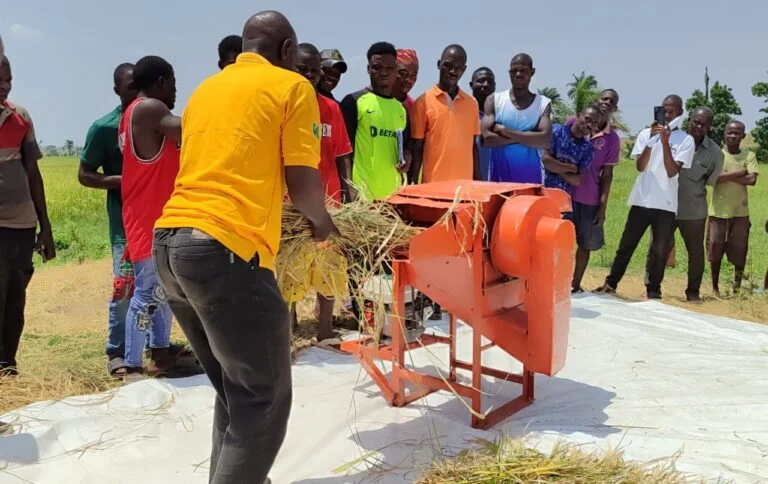
Mr Godwin Atser, Country Director of SAA, stated this at the “Brown” field day organised on Saturday for farmers in Lafia and Doma Local Government Areas of state.
Atser said that the training of the farmers on the mechanised harvesting system was part of the African Development Bank’s (AfDB) Policy and Human Resource Development Grant (PHRDG 1) being implemented by SAA in Nigeria and Benin Republic.
The country director, represented by the Mr Idris Garko, facilitator of the PHRDG 1 in the state, said that having trained the farmers to improve their rice yield using technology and best agronomic practices, it became imperative to introduce them to mechanised harvesting method that would help to reduce post-harvest losses.
According to him, studies have shown that rice farmers in Nigeria incur between 10 per cent to 35 per cent post-harvest losses using the manual traditional method of harvesting.
He, however, explained that with the use of simple machines like motorised reaper and thresher, such losses would be drastically reduced.

Atser added that the technologies would save the farmers cost in terms of labour and time, and ensure they got quality rice grains from farms for consumption and marketing.
He noted that although the machines are expensive and not readily available, SSA had identified indigenous innovative fabricators that could produce effective local versions of the imported machines and link up farmers to them.
“As part of this project, we recently brought these fabricators together in Lafia to interface and see how they could produce these machines. The outcomes of that engagement was quite impressive.
“We also link up the fabricators to dealers in spare parts for the machines to ensure easy assess,” he said.
The country director said that the farmer were encouraged to form cooperatives where they could pull resources together to acquire the machines since the machines might be too expensive to acquire individually.
“As a group, the machines would also serve as source of income for them. Apart from using it in their individual farms, they could generate revenue from it by using it for other farmers outside the group and be paid,” he said.
He further explained that the technical team of SAA would be around within the next two years to guide the farmers on the operations and routine maintenance of the machines.
Some of the farmers, who spoke to newsmen appreciated SSA for the intervention and expressed willingness towards acquiring the machines.
Mr Yusuf Kuje, a rice farmer in Alagye in Doma, said that the effectiveness of the machines in rice harvesting and threshing was unbelievable.
“You can see that a plot of rice farm that could take about 10 persons almost an hour to harvest using the manual traditional method, was done in just about 10 minutes with the use of the motorised reaper machine.
“The thresher is another interesting machine that saves time and energy that would have been dissipated in beating the rice. It threshes the dried rice seamlessly and the grain come out very clean.
“I will work closely with other farmers in my community to leverage the opportunity provided by Sasakawa to link us with the fabricators in order to get our own machines, ” he added.
Also, Mr Abdullah Otsonu, a rice farmer in Assakio, Lafia, said that given the effectiveness of the machines, rice production would become more exciting and interesting to the teeming youths in the community.(NAN)