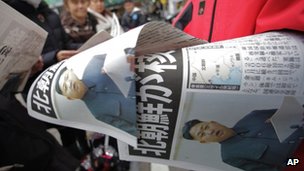
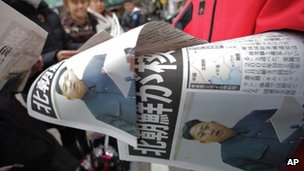
 Copies of an extra edition of a Japanese newspaper reporting North Korea’s nuclear test, 12 February 2013 News of North Korea’s nuclear test drew worldwide reaction, including in Japan.
North Korea says it has successfully conducted its third nuclear test, in a statement three hours after seismic activity was detected at its test site.
State-run news agency KCNA said the test “was carried out at a high level in a safe and perfect manner using a miniaturised and lighter nuclear device”.
The move elicited condemnation from several countries and leaders, including the US and China.
UN Secretary-General Ban Ki-moon
The secretary-general condemns the underground nuclear weapon test conducted by (North Korea) today. It is a clear and grave violation of the relevant Security Council resolutions.
It is deplorable that Pyongyang defied the strong and unequivocal call from the international community to refrain from any further provocative measures.
The secretary-general is gravely concerned about the negative impact of this deeply destabilising act on regional stability as well as the global efforts for nuclear non-proliferation.
US President Barack Obama
This is a highly provocative act that, following its 12 December ballistic missile launch, undermines regional stability, violates North Korea’s obligations under numerous United Nations Security Council resolutions, contravenes its commitments under the 19 September 2005 Joint Statement of the Six-Party Talks, and increases the risk of proliferation.
The danger posed by North Korea’s threatening activities warrants further swift and credible action by the international community. The United States will also continue to take steps necessary to defend ourselves and our allies.
China’s foreign ministry
The Democratic People’s Republic of Korea [North Korea], heedless of widespread international opposition, has again carried out a nuclear test, to which the Chinese government expresses its firm opposition.
It is China’s firm stance to realise non-nuclearisation for the Korean peninsula and prevent nuclear proliferation and maintain peace and stability in north-east Asia.
Chun Yung-woo, South Korean senior presidential secretary
The nuclear test “is an unacceptable threat to peace and security on the Korean Peninsula and the region and a head-on challenge to the international community”.
“North Korea won’t be able to avoid grave responsibility.”
South Korean President-elect Park Geun-hye
I strongly condemn North Korea’s third nuclear test that was carried out in spite of strong warnings from us and the international community.
North Korea’s nuclear test is a grave threat to the Korean Peninsula and international peace, hampers inter-Korean trust-building and undermines efforts for peace.
Japan Prime Minister Shinzo Abe
(The test) is a grave threat to the safety of our country and a serious challenge against the global framework of nuclear disarmament and non-proliferation.
It cannot be tolerated, as it will significantly damage safety and peace in northeast Asia and the international community.
UK Foreign Secretary William Hague
I strongly condemn this development, which is a violation of UN Security Council Resolutions 1718, 1874 and 2087.
The UK will begin urgent consultations with Security Council partners calling for a robust response to this latest development.
North Korea has a choice to make: it can either engage constructively with the international community, cease developing its nuclear and ballistic missile programmes and return to negotiations, or face increasing isolation and further action by the Security Council and the international community.
IAEA Director General Yukiya Amano
This is deeply regrettable and is in clear violation of UN Security Council resolutions. The Director General strongly urged the DPRK to fully implement all relevant UN Security Council resolutions and all relevant IAEA Board of Governors resolutions.
The IAEA remains ready to contribute to the peaceful resolution of the DPRK nuclear issue by resuming its nuclear verification activities in the country as soon as the political agreement is reached among countries concerned.