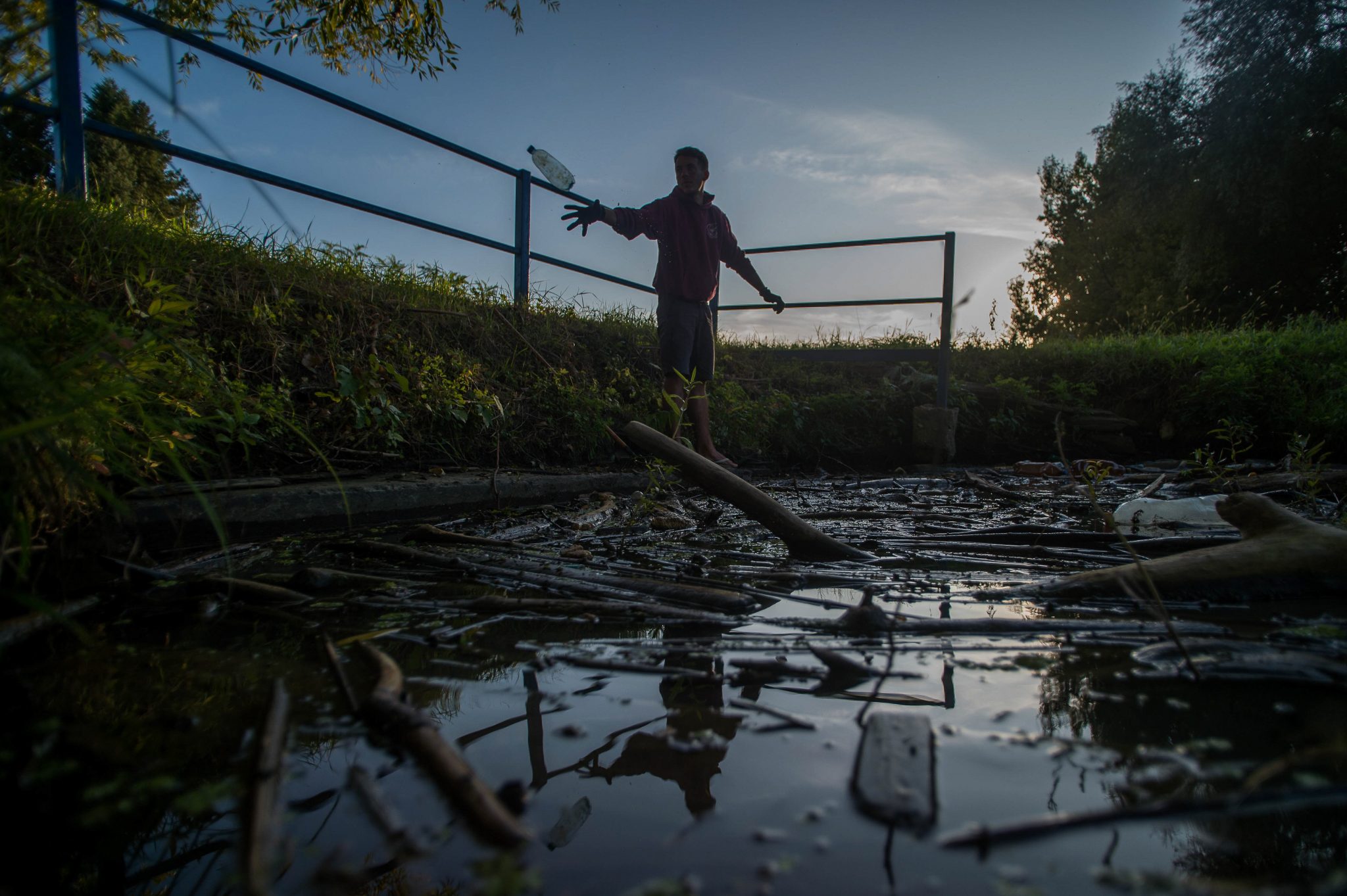
Hungary’s president called on Ukraine and Romania on Tuesday to stop polluting two major rivers that flow across Hungary after floods in the past weeks brought in “dirty carpets” of plastic bottles from its neighbours.
In letters to Ukrainian President Volodymyr Zelenskiy and Romanian President Klaus Iohannis, published on President Janos Ader’s official website, Ader said Hungarian authorities could not clean up all the waste in the Tisza and Szamos rivers.
“It is disappointing that pollution of the Tisza river with waste has not been reduced … and poses a lasting threat to the fragile ecosystem of the river,” Ader said in the letter to Zelenskiy. He asked the Ukrainian president to help to resolve the problem urgently.
“Our machines are no longer able to handle the piles of garbage that come in unstoppable quantities,” Ader said.
Ader, whose role in Hungarian politics is largely ceremonial, said in the letters that since mid-June Hungarian authorities had removed 938 cubic metres of waste from the Tisza river and 846 cubic metres of waste from the Szamos river.
The Tisza, one of the main rivers in eastern Europe, starts in Ukraine and flows across Hungary to join the Danube in Serbia. The Szamos flows from Romania to Hungary and joins the Tisza there. Massive pollution on the two rivers has been a problem for years.
The Ukrainian and Romanian presidents’ offices were not immediately available for comment.
The environmental issues in Hungary, including climate change and endangered species, affect these large waters and are also affected by them. Soil pollution, air pollution, and water pollution are the three biggest and pressing issues currently receiving the most attention by Hungarian officials in the European Union (EU) (land, resources, and environmental issues).
In Hungary’s history, rapid industrialisation beginning in the late 1800’s and into the turn of the century is what scholars believe to be one of the main attributes to these environmental threats. Unfortunately, factors such as poor industrial practices, poor agricultural practices, and lack of an affective waste management system are said by environmentalists to be adding to these serious issues, threatening the livelihood of the Hungarian people and those surrounding them. Acid rain, run-off, soil erosion and desertification are but some consequences of the growing concerns for the EU.
Currently, the main contributors to Hungary’s air pollution are car emissions and electric power plants. They emit dangerous amounts of sulfur-dioxide into the air by burning high-sulfur coals, diesel, and other sulfur-containing fuels. Sulfur-dioxide is especially toxic to people with asthma and to small children (cars, trucks, & air pollution). Emissions from power plants and cars tend to rise very high into the atmosphere and dissolve easily into the water in it, forming acid rain. Sulfur-dioxide is also very light and can travel in the air, as it does in Hungary and to as well as from its neighbouring countries.
Additionally, soil pollution is also a major issue. One contributor is hypothesized to be poor agricultural techniques practiced by many farmers along with the obvious contributor, namely industrial waste. In reference to agricultural practices, four specific pesticides are commonly used and contribute most to run-off and soil pollution: Atrazine, Acetolchlor, Propizochlor, and Chlopyrifos. These chemicals which are applied to pure and otherwise fertile soils seep into the earth and into the groundwater, also affecting the water pollution. Run-off occurs as a result of acid rain and deforestation eroding the soils, affecting the lands around the bodies of water the most. The polluted soil then runs into the various water sources. The connection between air and soil pollution then contributes to the very dangerous water pollution issue.
Perhaps the most important environmental issue addressed by Hungarian officials and felt across the country is water pollution. The causes and effects of the other two issues relates to the problem with water. Water pollution is more difficult to fix because it requires more time and proper care. Moreover, it cannot be fixed unless the soil is cleansed and the air is detoxified. The Balatan Lake is the largest lake in the Eastern European region and is a very popular tourist destination. But Lake Balatan is also very heavily polluted. Because it is indirectly drained by the Danube River, which not only crosses through Hungary but many other countries, the river flow brings in polluted soil run-off and polluted water from those surrounding countries as well. Run-off is only a minor cause of soil and water pollution as a result of agricultural pesticides and is a bit more prominent in careless industrial waste disposal but as simulated in the experiment documented by Judit Ferenczi, simulating farm run-off, a heavy amount of rain water can cause commonly used pesticides to seep into one of Hungary’s most crucial water supply, the Balatan lake.
Furthermore, industrial plants are continually releasing toxic chemicals into the air, polluting the moisture in the atmosphere. Acid rain then falls onto and destroys the forests and soil. The rivers running through Hungary’s lands carry these polluted soils and waters, spreading the pollution across the country (Land, Resources, and Environmental Issues).
This makes the water unusable and threatens the water supply presently sustaining the population. Currently, sewage treatment is not optimal and is another major cause of pollution in the water. The Hungarian government has implemented treatises to try to improve sewage treatment specific to the pollutants infecting their major water sources.