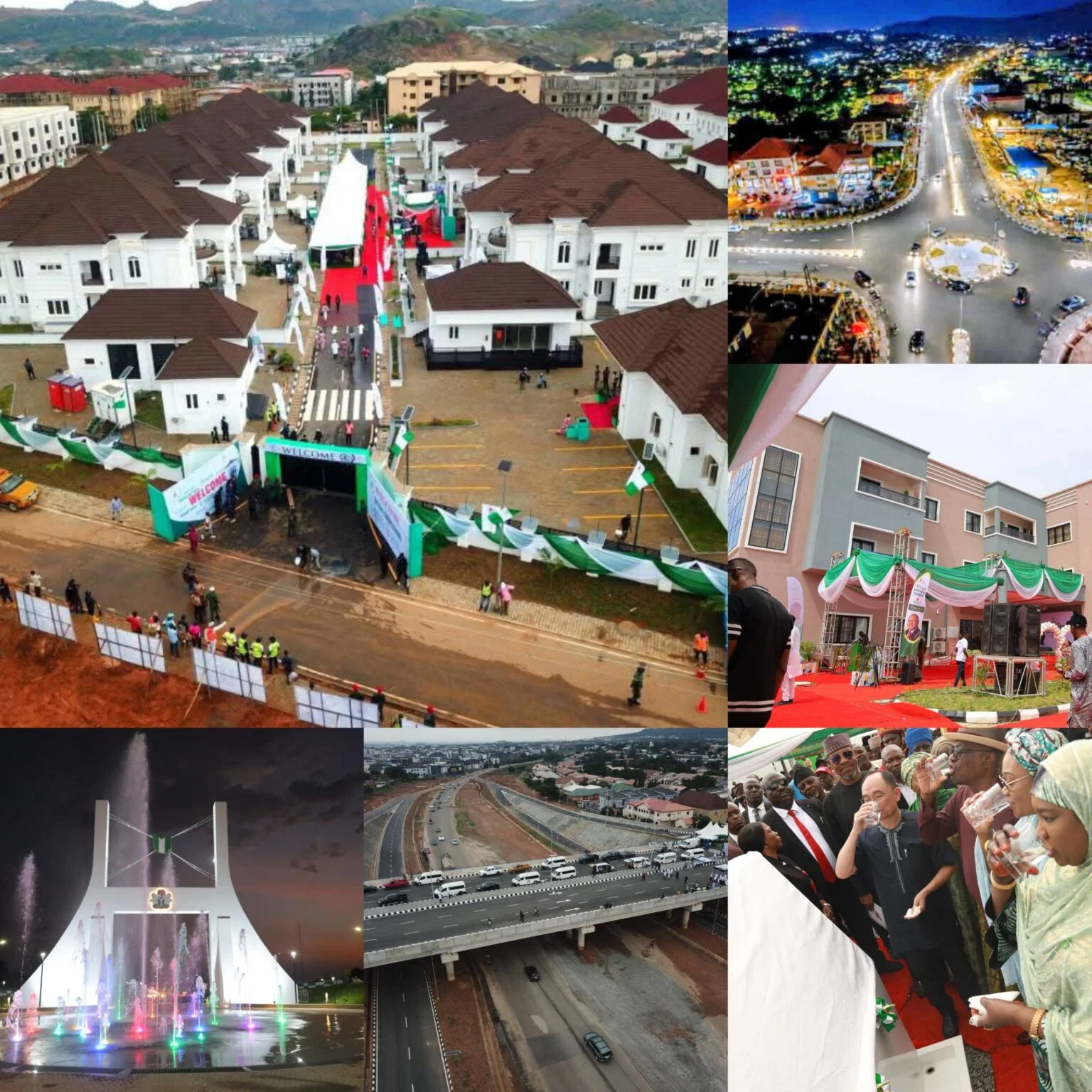
Under the aggressive urban renewal drive of the Minister of the Federal Capital Territory (FCT), Mr Nyesom Wike, massive flyovers, expanded carriageways, and newly paved roads are slicing through the FCT and its satellite towns.
In the first year of President Bola Tinubu’s administration, nine projects were executed and inaugurated, while 19 were executed and inaugurated to celebrate the president’s second year in office.
To celebrate Tinubu’s third year in office, the Wike-led FCT Administration inaugurated 31 projects in 28 days, out of which four were new projects.
The projects range from roads and interchanges, water supply, housing for judicial officers, and court premises, to the remodelled Abuja City Gate, the sales office, and the experience centre of the Abuja City Walk, among others.
Yet, behind the gleam of freshly laid asphalt and concrete lies a polarising debate on the true purpose of the ongoing infrastructural transformation in the nation’s capital city.
The debate hinges on whether the aggressive construction boom is a monument of paved progress genuinely connecting communities, or a rising expanse of concrete castles that favours elite aesthetics over the socio-economic reality of ordinary residents.
As the city hardens into a perceived fortress of elite infrastructure, critics are left asking if this rapid urban expansion is paving a path to shared economic opportunity or simply laying asphalt and erecting concrete castles at the expense of the poor.
The critics, while noting the unprecedented infrastructural stride in the FCT, expressed concerns over what they perceived as “over concentration on road infrastructure” at the expense of other sectors like water, health and education.
One of the critics, a former Minister of Youth and Sports, Solomon Dalung challenged the claims of infrastructural progress in Abuja under Wike, arguing that Abuja suffers from inadequate essential services.
“I think there is misrepresentation of progress and limiting it to the elites alone or privileged class; it’s unfair.
“In Abuja, I know there’s no water. Most people support themselves with private initiatives through boreholes.
“The public school system in Abuja is not different from those in any part of Nigeria. The healthcare delivery system is of course like a transit camp.”
According to him, genuine development should prioritise initiatives that directly impact the lives of ordinary citizens, such as access to education, healthcare, and water.
“These are the services that affect common people directly, not road construction.
“How many poor Nigerians have vehicles? So, we cannot be emphasising road construction as development,” he said.
“Similarly, the spokesman of the African Democratic Congress, Malam Bolaji Abdullahi, while reacting to Bayo Onanuga’s comments on what he described as an overblown level of hunger in the country, said, “Nigerians can’t eat road”.
Onanuga, Special Adviser to Tinubu on Information and Strategy, had argued that he did not personally observe the overblown level of hunger that critics and the media complained about in the country.
But Abdullahi argued that a sensible government did not measure the effects of its policies merely by looking at the people within its immediate circle or driving through paved roads.
In the same vein, Sen. Ireti Kingibe, representing FCT at the Senate argued that most residents were not benefiting from the new infrastructure development in Abuja.
While acknowledging ongoing road construction projects across the FCT, Kingibe accused Wike of making life difficult for residents since assuming office in August 2023.
According to her, while constructing road infrastructure, the minister has failed to prioritise the needs of the majority of residents.
However, policy makers have long agreed in investing in public infrastructure as a means of reducing geographical disparities and promoting growth, describing infrastructure as a “prerequisite” for economic development.
Experts equally insist that overwhelming balance of evidence suggests that infrastructure improvements were critical in supporting the development process of any society.
Wike, in particular, had buttressed this point in different fora, when he described road infrastructure as the “ultimate engine of development”.
In a lecture titled, “The Impact of Political Leadership on Infrastructural Development in Nigeria: Between Dividends of Democracy and Good Governance”, Wike emphasised that “infrastructure is more than concrete and steel”.
Delivering the lecture at the 2026 Annual Distinguished Personality Lecture Series, organised by the Faculty of Social Sciences, Yakubu Gowon University, Abuja, the minister noted that while other sectors were important, “road infrastructure leads the way.”
“Infrastructure is not simply roads and bridges; it is the circuitry of nationhood; it connects destinies, unlocks human potential, and provides the physical and digital foundations upon which national transformation rests.
“No nation becomes great without robust infrastructure, the architecture of equality, dignity, inclusion, productivity, and hope.
“It is for this reason that infrastructure, particularly road, remains the most honest measure of governance, the clearest language through which governments reveal their priorities, values, and seriousness of purpose.
“Without roads, you cannot go to hospital, you cannot go to school, and you cannot go to farm,’’ he said.
Observers say this unyielding developmental philosophy from Wike captures the very essence of his aggressive urban renewal drive.
In Wike’s vision for the FCT, “infrastructure is the supreme engine of economic survival”, an unwavering conviction that turned the nation’s capital into a hyper-active construction zone.
The minister has vigorously defended his multi-billion-naira infrastructural projects, viewing the expansive corridors and flyovers as the non-negotiable panacea to unlocking Abuja’s commercial and social potential.
Beyond road infrastructure, the minister said that Tinubu’s vision in FCT extends far beyond asphalt and concrete, pointing at the quieter revolution taking place in other critical sectors.
Wike argued that contrary to critics’ perceived overconcentration on road projects, the Tinubu administration is also investing hugely in water, education, health, sanitation and other critical sectors.
He pointed at the massive rehabilitation of public schools, provision of patrol vehicles to security agencies and construction of bus terminals, to the expansion of rural healthcare and critical clean water networks.
In his governance model, health insurance enrolment, safe water supply projects in places like Bwari, Karu and adjourning communities and classroom renovations were deeply tied to physical connectivity.
This structural push extends deeply into the educational and Water, Sanitation, and Hygiene (WASH) ecosystems, directly targeting the historical decay of Abuja’s satellite towns.
For instance, Wike’s WASH efforts culminated in the inauguration of the massive 470-million-dollar Greater Abuja Water Supply Project by Tinubu in 2025.
Tinubu said that the project, when completed, would expand the capital’s portable water supply capacity from 240,000 to 720,000 cubic meters per day and secure clean water access for over three million residents.
Equally, Tinubu, represented by Vice President Kashim Shettima, inaugurated the Karu and Bwari Water Supply Network in June 2026 as part of efforts to provide portable water to satellite towns.
The President, while inaugurating another water supply network in Bwari, equally promised to extend portable water supply to all satellite towns and area councils of the FCT.
Also, proponents of Wike’s roads-as-a-panacea for development model argue that “road construction was not an end in itself, but the literal vehicle required to deliver social services”.
Under this framework, physical connectivity acts as the foundational pivot for human capital, enabling access to schools, healthcare, and clean water.
Dr Adedolapo Fasawe, Mandate Secretary, FCT Health Services and Environment Secretariat, buttressed this position when she argued that emergency medical interventions were meaningless if logistics were bottle-necked by failing terrain.
To bridge this gap, Fasawe said that the FCT Administration had distributed a new fleet of 12 advanced ambulances to FCT general hospitals to leverage the newly optimised arterial roads.
Concurrently, the mandate secretary said that the administration was also revitalising and equipping long-abandoned healthcare infrastructure across the territory.
She added that beyond bricks and mortar, the human element was being funded through aggressive expansion of the FCT Health Insurance Scheme.
This, she said, surpassed its enrolment baseline to bring formal health coverage to tens of thousands of vulnerable residents, including the more than 1,500 inmates enrolled across FCT correctional centres.
In the education sector the Mandate Secretary, Dr Danlami Hayyo, said that under an unprecedented multibillion-naira intervention, contracts for the total renovation and rehabilitation of more than 100 public schools were awarded in 2024.
Hayyo added that the move did not end with just the rebuilding of dilapidated classrooms, but the simultaneous installation of modern furniture and dedicated water supply systems.
He added that as at October 2025, 43 schools out of the 108 have been completed and fully equipped, while others were ongoing.
Acknowledging the efforts, Principal of School of the Gifted, Gwagwalada, Mr Bello Adamu, said that the school, grappling with dilapidated facilities and crumbling infrastructure, has undergone a remarkable transformation thanks to Wike.
“Before the Minister’s intervention, the school was in a state of sorrow, with cracked walls, broken toilets, and a roof that was falling apart, making learning nearly impossible,” he said.
Also, Etsu Kwali, Luka Nizassan III, said that the rehabilitation of schools is already improving access to quality and inclusive education in public schools across the FCT.
“Learning spaces are now safer and more conducive. These potent learning opportunities are already yielding great results,” the traditional ruler said.
While observers say new satellite town roads and infrastructural turnaround in the FCT relieve everyday citizens and small-scale traders, critics argue that the government must also invest heavily in social programmes to truly raise living standards for vulnerable people. (NAN).