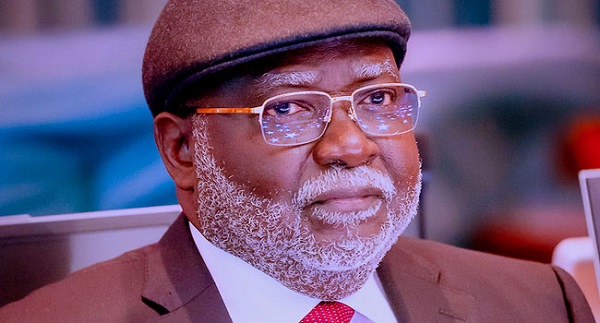
Earlier in the week, the Chief Justice of Nigeria, Justice Olukayode Ariwoola speaking on the Nigerian judicial system claimed that Nigerians are the most litigious people in the world while advising them to seek alternative means or resolutions.
He made this remark was made at the special session of the Supreme Court held to mark the beginning of the 2022/2023 legal year and the swearing-in of 62 newly conferred Senior Advocates of Nigeria, (SAN).
In his words: “In every little disagreement we rush to court; and in every lost case we rush to appeal, even up to the Supreme Court, no matter how little the issue might be. That has obviously accounted for the several appeals pending in Supreme Court.
“Though we receive scathing criticisms from members of the public over our over-blotted docket, we are neither in any position to regulate case inflow to the court nor the supernatural powers to attend to all in one fell- swoop.
“Our pending (backlog) civil appeals are 4,741 while the number of pending (backlog) criminal appeals is 1,392.
“On the other hand, we have 751 moribund appeals for disposal. That brings the total number of pending (backlog) appeals in this court to 6,884.”
Justice Ariwoola said the judiciary is doing its possible best to ensure Nigerians have a working and better justice system in Nigeria.
“Available facts on judicial activities in various jurisdictions across the globe still emphatically confirmed that the Supreme Court of Nigeria remains the busiest and most hardworking Supreme Court in the world.
“It is on record that we work from Monday to Friday every week. We conduct sittings on daily basis. It is only on Wednesdays that we do Chamber sitting to consider non-contentious matters. On Fridays, we deliver judgments and rulings.
“We are humans and equally have blood running through our veins; if no one praises us, we have the inalienable right and obligation to praise and eulogize ourselves,” the CJN said.
According to research published on Academia, titled: The most litigious Countries in the World, Nigeria is not part of the top ten countries nor is she part of the countries with the most available lawyers.
Here’s a list of countries with the highest number of lawyers per capita:
- U.S. 1 lawyer for every 300 people
- Brazil: 1 lawyer for every 326 people
- New Zealand: 1 lawyer for every 391 people
- Spain: 1 lawyer for every 395 people
- UK: 1 lawyer for every 401 people
- Italy: 1 lawyer for every 488 people
- Germany: 1 lawyer for every 593 people
- France: 1 lawyer for every 1,403 people
Here is a list of the top 10 most litigious countries (for every 1,000 persons)
- Germany: 123.2
- Sweden: 111.2
- Israel: 96.8
- Austria: 95.9
- U.S.: 74.5
- UK (64.4)
- Denmark (62.5)
- Hungary (52.4)
- Portugal (40.7)
10. France (40.3)
With Nigeria not shown on the map for having the most lawyers nor being the most litigious country, the backlog from the 2021/2022 legal year which is an eyesore has a different problem root that needs to be addressed.
On 24 October 2011, a Report of the National Judicial Council (NJC) Subcommittee on Speedy Dispensation of Justice reported that some 75% of cases on court dockets all over the country, ought not to be there in the first place. They were frivolous or unnecessary because litigants exploit loopholes and deliberately frustrate other parties and protract the matter for as long as possible.
One of such factors responsible for the delay experienced in the smooth, efficient, and quick disposal of cases is called delay tactics where the counsel adopts raising preliminary objections challenging the jurisdiction of the trial court or on mere irregularity, or on the validity of a charge itself based on some perceived defects. Another weapon used by counsel in a malicious manner to frustrate and delay proceedings is the right to appeal whether substantive or interlocutory.
While the CJN advised Nigerians to seek Alternative Dispute Resolution, the court can shorten the life span of a case if it imposes punitive costs and penalties for default of appearance or delay in the filing process, or delays in compliance with the rules of the relevant court as it was used by Lagos State Judiciary in 2008 after Justice Opeyemi Oke raised a committee named, Backlog Elimination Programme (BEP) aimed to decongest the courts by re-evaluating old cases and finding ways of resolving them through Alternative Dispute Resolution (ADR) or accelerated hearing
While the Chief Justice of Nigeria blames Nigerians for being litigious, Justice Opeyemi Oke acknowledges the delays in the system and acted towards it.
“Delay has led to public ridicule of the judiciary which is supposed to be the hope of the common man. This delay, coupled with the continuous filing of new cases has led to congestion in Courts with a ridiculous number of a backlog of cases, the result of which the courts are now in a state of emergency,” She noted.
Aside from Alternative Dispute Resolution, the use of a digital case management system is another way of reducing delays in justice in Nigeria. The information gathered through the system can then be analyzed to inform decision-making and policy with a view to improving the efficiency and effectiveness of court operations.
From January to March 2020 the average time taken for small claims and multi/fast track claims to go to trial was 39.7 and 59.6 weeks at the magistrate court while in Nigeria it takes an average of 85.3 weeks for a magistrate court.
Between the 1940 and the 2000s it takes an average of 52 weeks for a civil case to come to a conclusion in the US, however, after reliance on technological advancement, the days are now shorter.
Nigeria is not the most litigious country in the world and even with that it takes longer time to conclude both civil and criminal justice in the country but that can be improved if Nigeria judicial system sees this menace as an emergency just like Justice Opeyemi Oke proclaimed it and work in tune with the available technology.