By Akinwole Happiness
LAGOS — Stakeholders in Nigeria’s energy and extractive industries have called for stronger regulatory reforms, increased investment and greater collaboration to accelerate decarbonization while sustaining economic growth and expanding energy access.
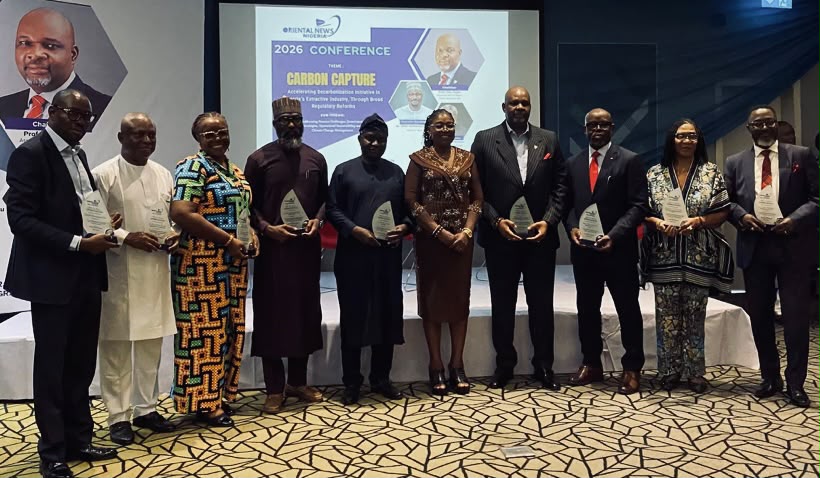
The call was made at the fifth edition of the Oriental News Nigeria Conference on Carbon Capture, themed “Carbon Capture: Accelerating the Decarbonization Initiatives in Nigeria’s Extractive Industry through Broad Regulatory Reforms,” held in Lagos.
Speaking at the opening of the conference, the convener and Publisher of Oriental News Nigeria, Mrs. Yemisi Izuora , said the event was designed to bring together industry leaders, government agencies, investors and experts to explore practical solutions for reducing carbon emissions and promoting sustainable practices in the extractive sector.
She noted that while the extractive industry remains critical to Nigeria’s economic development, its environmental impact underscores the need for innovation, investment and effective regulatory frameworks to support sustainable growth.
Former Minister of Information, Chief Lai Mohammed , described decarbonization as an urgent necessity that requires innovation, responsible investment and strategic partnerships among governments, regulators and industry leaders.
He identified financing as one of the major obstacles to scaling clean energy infrastructure across Africa, stressing the need for innovative financial models, carbon markets and long-term investment frameworks.
_”Financing remains one of the greatest barriers to scaling clean energy infrastructure across Africa,” Mohammed said._
He also emphasized the importance of policy certainty in attracting investment, noting that sustainability has become a key indicator of corporate leadership and competitiveness.
_”Sustainability is no longer simply about compliance. It has become a competitive advantage and the measure of corporate leadership,” he added._
Chairman of the occasion, Prof. Silk Ogbu , Associate Professor of Management Communication at Lagos Business School, urged stakeholders to move beyond ambitious declarations and focus on measurable climate action and operational sustainability.
He noted that decades of resource extraction have created a responsibility for industries to contribute to environmental restoration and sustainable development, adding that meaningful climate action requires clear targets and effective implementation. Ogbu also observed that environmental damage often goes unaccounted for because its costs are difficult to quantify, remarking that _”the atmosphere never sends an invoice.”_
Delivering the keynote address on behalf of the Managing Director and Chief Executive Officer of the Rural Electrification Agency (REA), Dr. Abba Abubakar Aliyu, Mr. Gboyega Ayoade said Nigeria’s decarbonization efforts must balance environmental objectives with economic growth, industrialization and energy access.
The keynote address stressed that decarbonization should not be viewed solely as an environmental issue but as an opportunity to strengthen energy security, support industries and promote inclusive economic development.
Mr. Gbenga Ayoade highlighted ongoing renewable energy initiatives, including captive power projects for federal universities and mini-grid deployments aimed at expanding access to clean electricity.
_”The challenge is not simply to reduce emissions, but to expand energy access, grow the economy, industrialize, and reduce emissions at the same time” Ayoade said_
Also speaking, Engr. Leiste Aihevba, representing the Group Managing Director of Sahara Group, Engr. Kola Adesina, emphasized the need for stronger financing mechanisms and practical implementation of sustainability initiatives.
He noted that the global climate conversation now requires industries to move beyond extraction and contribute towards environmental restoration.
_”For 70 years, the extractive industry has focused on taking things from the ground. Now, the world requires us to learn how to put something back” he said._
Aihevba stressed that climate ambitions must be backed by adequate funding and investment strategies.
During a panel discussion moderated by Dr. Charles Ebereonwu, Principal Consultant and Trainer at CETTLE Consulting Nigeria Limited, participants examined Nigeria’s pathway to net-zero emissions while addressing the country’s energy and development needs.
The panelists also stressed the need to ensure that climate action does not come at the expense of industrial growth and economic development.
The panelists agreed that achieving Nigeria’s climate goals will require stronger collaboration among government institutions, businesses, financiers, regulators and development partners, backed by practical implementation, sustainable policies and increased investment in low-carbon technologies.