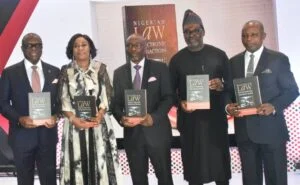
The Attorney-General of the Federation (AGF) Prince Lateef Fagbemi (SAN) and his Lagos State counterpart Lawal Pedro (SAN) have called for a legal framework for electronic transactions.
They made the call on Tuesday in Lagos, at the presentation of the book titled: Nigerian Law of Electronic Transactions.
The book was written by former Lagos Attorney-General and Commissioner for Justice, Adeniji Kazeem (SAN).
The book, reviewed by Mr Gbenga Omolokun, Managing Director, VFD Microfinance bank, is made up of 180 pages with six chapters.
Fagbemi, who chaired the event, noted that every sphere of human existence could no longer feign ignorance of the pervasive effect of information and communication technology.
“This has even become more pronounced with the proliferation of Artificial Intelligence, wherein physical human involvement is now gradually being limited and/or phased out in the way we live and do business.
“Expectedly, therefore and as legal professionals, we cannot but take the bull by the horns in proffering the ground rules for a seamless transition from our present situation to this new world order.
“As we navigate the 21st century, the intertwined nature of law and technology becomes increasingly desired.
“The legal framework governing electronic transactions is critical to ensuring trust, security, and efficiency in our digital economy.
“This book is a timely and invaluable addition to our legal literature, addressing the complexities and nuances of electronic transactions in Nigeria,” he said.
Fagbemi commended the author for his dedication and insightful contribution to this dynamic field of law.
He said the book was timely and could not have come at a better time.
“I commend Mr. Kazeem for his foresight and commitment to advancing legal research and practice in this area.
“His work during his tenure as the attorney general and commissioner of Justice for Lagos State, laid a solid foundation for the integration of technology into our legal processes and this book is a testament to his enduring vision and effort,” the AGF added.
On his part, Pedro said electronic transactions had become a regular part of life and required regulation.
“The legal framework is crucial to guarantee the trustworthiness of electronic transactions,” he said.
According to him, the state is already leveraging technology in the payment of taxes, land use charge, electronic court filing and others.
He added that Lagos was at the forefront of the digital revolution.
According to him, the opportunities will not be fully harnessed, including job creation, unless there is a strong legal framework for such transactions.
Chief Judge of Federal High Court, John Tsoho, represented by Justice Ayokunle Faji, hailed Kazeem for his contribution to knowledge, saying the book came at the right time.
“It will be a good source of assistance to judges and I am advocating the need for standalone legislation on electronic transactions,” he noted.
Earlier, the author of the book, Mr Kazeem, said the inspiration to write the book arose from witnessing the rapid digital transformation reshaping commercial transactions across Nigeria and the globe.
According to him, data from the Nigerian InterBank Settlement Systems Plc (NIBSS) shows that the value of electronic payment transactions reached a staggering N600 trillion in 2023, a 55 per cent increase from N387 Trillion in 2022.
He noted that transaction volume had also seen a significant rise from 5.1 billion in 2022 to 9.7 billion in 2023.
“While these figures may not all translate to completed commercial transactions from a purely legal standpoint, they undeniably point toward a massive increase in digital transactions across the nation,” he said.
The surge in commercial technology, Kazeem noted, offered a wealth of opportunities for the government, as it streamlined public service delivery from easy online tax payments, to efficient distribution of social programmes.
He also noted that a thriving digital commerce landscape benefited the nation through increased tax revenue from transparent e-transactions, economic growth fueled by a flourishing digital economy and financial inclusion.
It also fosters good governance by leaving an auditable trail that combats corruption, the SAN noted.
Mr Kazeem said there was therefore, a need for a legal framework.
He explained that it was necessary to know which legal framework applied, if a dispute over an electronic transaction arose, as well as at what point such transactions became contracts.
“Technology’s rapid evolution demands a legal system that adapts to protect its citizens and which serves the growing FinTech and technology sectors.
“While industry summits often touch on regulatory compliance, the crucial aspect of legal protections for the users remains largely unexplored. This book aims to bridge that gap.
“It delves into how the law can provide those safeguards. By contributing to this knowledge base, I hope to empower everyone and fuel the creation of a comprehensive electronic transactions law in Nigeria,” the author said.
NAN reports that dignitaries at the book presentation include former Federal Commissioner for Works, Mr Femi Okunnu (SAN) and a former All Progressives Congress (APC) National Legal Adviser Babatunde Ogala (SAN).
Also at the ceremony was a former Lagos Attorney-General and Commissioner for Justice Olasupo Shasore (SAN), among others. (NAN)