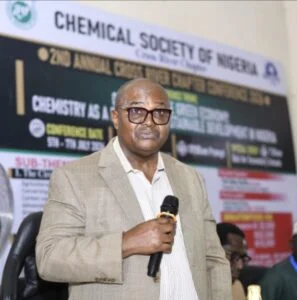
The Vice Chancellor of the University of Calabar (UniCal), Prof. Offiong Offiong, says Nigeria’s economic diversification and sustainable development depend largely on technological innovation and scientific advancement.
Offiong said this on Wednesday in Calabar, while declaring open the 2nd Annual Conference of the Chemical Society of Nigeria (CSN), Cross River State Chapter.
The conference themed ”Catalyzing the Green Economy: Chemistry as a Driver for Sustainable Development in Nigeria”, brought together academics, researchers, industry experts and policymakers to explore the role of chemistry in driving sustainable national development.
He described chemistry as a cornerstone of global sustainability, providing innovative solutions in renewable energy, agriculture, healthcare, waste management and industrial development.
He said chemists play a critical role in developing green technologies capable of stimulating economic growth while safeguarding the environment for present and future generations.
He urged participants to ensure that the ideas and recommendations emerging from the conference were translated into practical actions that would strengthen the chemical sciences and accelerate Nigeria’s transition to a green economy.
Also speaking, the Alternate Chairman of the Local Organizing Committee, Prof. Ayi Ayi, said the conference would promote knowledge exchange and foster innovative solutions to national and global development challenges.
According to him, discussions would focus on environmental remediation, resource management, the circular economy, resource valorization, chemical education and capacity building, underscoring the relevance of chemistry to everyday life.
Ayi commended Offiong for his administrative support, generosity and commitment, describing them as instrumental to the successful hosting of the conference.
In his remarks, the President of the Chemical Society of Nigeria, Prof. Rufus Sha’Ato, called for stronger collaboration between universities and industry as well as increased investment in scientific research.
Sha’Ato represented by the Society’s Vice President (South-South), Dr Frank Oteiva, identified pollution, waste management, climate change, energy and food security as priority areas requiring sustained research and innovation.
He urged policymakers to create an enabling environment that supports research, innovation and the commercialization of scientific discoveries.
Earlier, the Chairman of the state chapter of the CSN, Mr Stephen Adalikwu, said the conference reaffirmed the society’s commitment to advancing the chemical sciences in spite of challenges.
He listed the challenges to include inadequate funding, weak industry linkages and poor research infrastructure.
The event also featured the presentation of prizes to secondary school students who excelled in a chemistry quiz competition organized by the society.(NAN).